Our concerns after Donald Trump’s first election quickly led to our ethics conference at Yale School of Medicine, with many of America’s leading psychiatrists, and then to our bestselling book later that year in 2017.
We realized from the start that the purpose, and the responsibility, of experts is to know when to use our expertise to protect society and to avoid having society suffer through foreseeable calamities by dealing with psychiatrically-dangerous persons in advance, before they can bring about what are preventable disasters. As psychiatric professionals, we clearly warned then, and continue to do so, that because of Donald Trump’s severe mental impairments he must be immediately contained, one way or another, and if this were not done he would escalate until he became unstoppable, as is now the case.
Many now ask, more than nine years later, what is the solution to our situation? The first major step, much more difficult now, is to set straight the role of mental health experts as the primary consultants needed to contain a dangerously mentally-impaired person with presidential powers who must be restrained and stopped.
In the twenty-first century, we should no longer invoke “miasma”, spirits, or even supernatural political theories to deal with medical issues that have been thoroughly scientifically studied. The same holds true of psychological medicine. We know what it is, and we know what works. Psychiatry holds no different position in medicine than any other specialty, other than the affected organ: the mind/brain.
We were seriously led down the wrong path when the American Psychiatric Association (APA) singled out and stigmatized the whole field, finding an opportunity to gain federal funding—which it did, in unprecedented ways—by going against science and by discrediting us through the false claim that we were diagnosing.
Diagnosis was never the point. Narcissistic personality disorder and frontotemporal dementia—as well as a dozen more differential diagnoses—may be correct, but they are distractions. They may be curiosities the public can use the occasion to learn about, but they are secondary to the emergency at hand—which is public safety, including nuclear danger.
It is understandable that the public thinks in terms of diagnosis and asks for it, but it was the role of mental health experts to educate the public that the real issue is mental unfitness and dangerousness. These are evaluations mental health experts are obligated to do even before diagnosis, and regardless of patient status (in fact, a physician does not have the option not to take a person as a patient when danger is involved). Even when a dangerous person is contained, we are still regularly called upon to assess mental capacity or violence risk by courts, prisons, boards of directors, and governments, and we are encouraged to serve in this role as part of our responsibility to society. This responsibility is quite apart from the responsibility we have toward patients, including diagnosis by personal interview and under consent.
Had these issues been emphasized, instead of the false issues of “the Goldwater rule” and diagnosis, we would not have become targets for the APA and the New York Times—after meeting with the APA—and the public would not have been rendered so helpless. This is what we told U.S. Congress members, and one of the reasons why they urged us to “educate the public medically,” so that they could “intervene politically.” They were absolutely right in the division of our roles.
Another example of harm through public confusion is what George Conway did, when he wrote the Atlantic article that launched him to being the “expert” on the president’s mental health, after a lengthy discussion with me about the importance to focus on unfitness (before reverting back to his amateur fascination with diagnosis). Even though he made use of everything I told him, he did not list me as coauthor or even mention me. What I actually encouraged him to do was even greater: I urged him to do what legal professionals know best to do, which is to defer to experts in areas one does not have expertise in and to bring focus to the experts rather than oneself. He had no such intention, and I was shocked to discover that he published his article without even an acknowledgment. I expressed that I expected better of him as a graduate of Yale Law School (where I was teaching at the time), which caused him to avoid me altogether. Instead, bypassing all the renowned and eminent psychiatrists, he joined hands with John Gartner—another man who does not care about the truth, as long as there is a positive public image.
We no longer live in a time when truth can be sacrificed for the sake of image. The truth is that the nation and the world are in an unremitting medical crisis, because the correct medical professionals are not called upon. I have written about how Gartner dangles entertainment before the public but does not educate about our critical role in intervention and behavioral management—which not even the media know how to ask about.
A rare article for the Independent began broaching the subject, pointing out important roles we have played for the CIA, regarding the Twenty-Fifth Amendment (whose author, John Feerick, emphasized that its invocation begins with data—often from medical experts—not the vice president), and having our knowledge equip a former White House Chief of Staff General John Kelly with the ability to avert nuclear war (the article did not capture this, but still outlined what a current White House chief of staff could potentially do).
Many are still far from recognizing this—that they should seek help—is nine-tenths the solution.
Announcement:
Dr. Bandy X. Lee is holding a meditation series on the theme:
“The Power of Being One”
The next session will be this Saturday, January 24, 2026, at 12 noon EST/9 a.m. PST on Zoom. A paid subscription is required to receive a link the morning before.
This is an informal series. Formal courses on major issues of our day will now be moved to the institute, Preventing Violence Now, beginning later this month. Stay tuned for classes with world-renowned scholars, movers, and shakers!
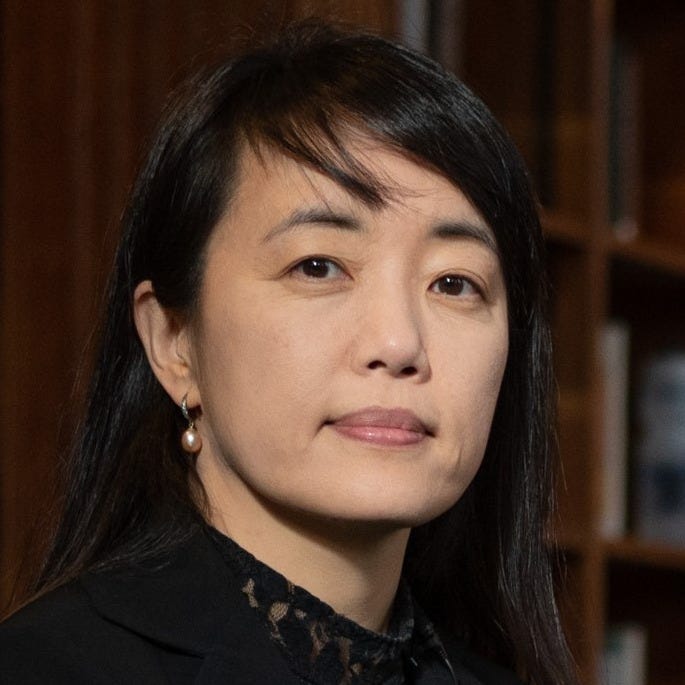
Dr. Lee is a forensic and social psychiatrist who studies human violence and also holds a master’s in divinity. She mainly worked with maximum-security prisoners and public-sector patients, before she became known to the public through her 2017 Yale conference and book that alerted against dangerous leadership. In 2019, she organized a major National Press Club Conference on the theme of, “The Dangerous State of the World and the Need for Fit Leadership.” In 2024, she followed up with another major Conference, “The More Dangerous State of the World and the Need for Fit Leadership.” She published another book on dangerous leadership that has recently been expanded, in addition to a volume on how dangerous signs in a leader spreads and two critical statements on dangerous leadership. As many of the dangers she warned against unfolded—including millions of unnecessary pandemic deaths, the propagation of political violence, the exacerbation of economic inequality, the destruction of democracy, the devastation of the climate, the replacement of international collaboration with hostile confrontation, a renewed and accelerated nuclear arms race, a global emboldening of dictators leading to brutal warfare and genocide, and growing state-sanctioned cruelty and human rights violations—she has advocated for another way. Now, the author of the internationally-acclaimed textbook, Violence; over 100 peer-reviewed articles and chapters; 17 scholarly books and journal special issues; and over 300 opinion editorials, is developing a curriculum to help humanity rise above its destructive course and to embrace an awareness of, “One World or None.”


Comments
Post a Comment