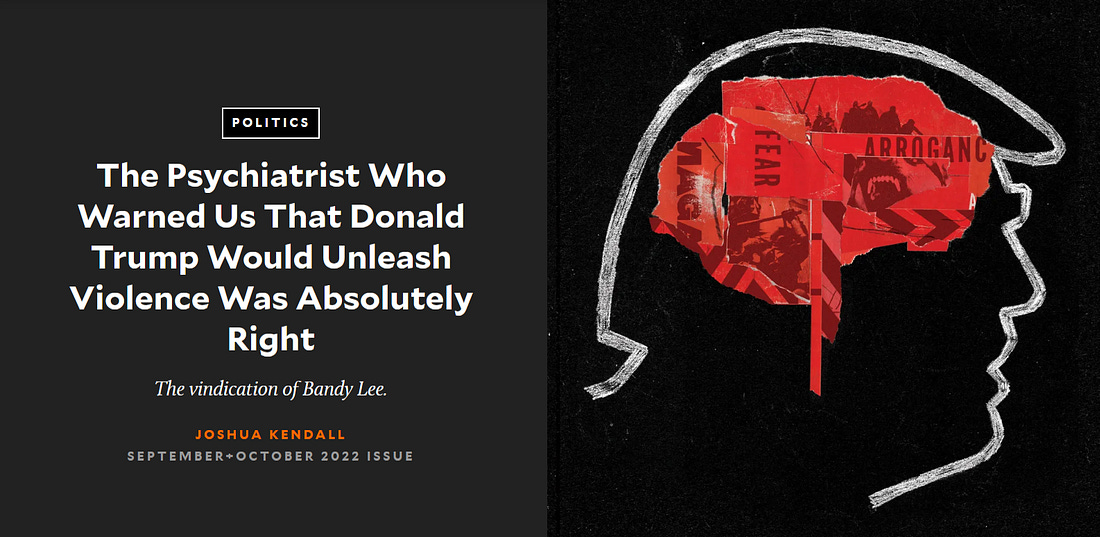
I was told that the magazine repeatedly reposted its article, “The Psychiatrist who Warned Us that Donald Trump would Unleash Violence was Absolutely Right,” throughout last week, surrounding the anniversary of January 6, 2021. I believe Mother Jones can be proud, for its decision to publish about us—while other media shunned us—was absolutely right. So was the journalist Joshua Kendall, who has written other courageous articles about us. The more time passes, and more violent acts accumulate, the more they will be proven right.
This is because I—and the world-renowned psychiatrists who joined me—correctly assessed that our expertise would be the most critical for intervention in our time. Before there was a political crisis, or a historical crisis, there was a mental health crisis, which we knew how to recognize, interpret, and treat—if only we were allowed. Here is an excerpt:
Lee … “suddenly realized that he had a lot in common” with [her violent offender] patients. “Trump was engaging in the predatory manipulation of his vulnerable followers.” In some cases, gang leaders might “ask their members to engage in violence and then issue bogus promises of protection. Like Trump, these leaders also often project extreme self-confidence, and that appeals to their followers, who tend to feel a deep emotional need for protection, connection, and identity”….
She decided to jump into the fray, organizing an academic conference that took place in New Haven the following April. Titled “Does Professional Responsibility Include a Duty to Warn?” the meeting featured a handful of prominent psychiatrists, including Robert Jay Lifton, author of The Nazi Doctors (1986), [Harvard Medical School’s Judith Herman, and New York University psychiatrist James Gilligan,] who addressed Trump’s mental state and the risks they believed it posed to the health and safety of Americans. Their consensus was, as Lifton put it, that psychiatric professionals had a compelling ethical duty to “bring our experience and knowledge to bear on what threatens us and what might renew us”…. The Dangerous Case of Donald Trump was a surprise bestseller, hailed by the Washington Post as “the most daring book” of 2017….
Shortly after the book came out, leaders of the American Psychiatric Association began publicly attacking Lee, arguing she was acting irresponsibly. Her alleged offense was violating the 1973 Goldwater Rule, an APA guideline stating that “it is unethical for a psychiatrist to offer a professional opinion” of anyone without conducting a personal examination and getting proper approval…. And yet Lee’s Cassandra-like warnings turned out to be remarkably prescient. On the morning of the insurrection, as former White House aide Cassidy Hutchinson revealed in sworn testimony to the January 6 committee, Trump had no compunction about unleashing armed loyalists on the Capitol, and was furious when told he could not accompany them. Two days later,… House Speaker Nancy Pelosi seemed to channel Lee when she told General Mark Milley, the chairman of the Joint Chiefs of Staff, “This unhinged president could not be more dangerous. And we must do everything we can to protect the American people from his unbalanced assault on our country.”
We also know from January 6 testimony that key Republicans—including House Minority Leader Kevin McCarthy and Cabinet secretaries such as Steven Mnuchin and Betsy DeVos—discussed the possibility of invoking the 25th Amendment, which provides for removal of a president who is no longer fit to discharge his duties due to a mental or physical disability.
The 25th Amendment was the very reason for which more than fifty Congress members consulted me in 2017 and 2018, following the success of my conference and book. All that followed might have been prevented—and I believe would have been, but for the interference of the APA.
As a pioneering scholar of violence, Lee has plenty to say about what can be done to address the growing disregard for law and democratic institutions that Trump helped normalize…. Ever since June 2015, when Trump descended the escalator in Trump Tower to announce his candidacy, he has repeatedly embraced violence in support of his political goals…. Instead of denouncing the white supremacists who organized the 2017 Charlottesville rally that turned violent, Trump said there were “very fine people on both sides.” And during his first debate with Joe Biden, Trump refused to condemn the Proud Boys, a violent extremist group that would play a pivotal role in the Capitol assault, instead telling them to “stand back and stand by”….
In addition to studying the perpetrators,… Lee also has consulted with government officials in Alabama, Connecticut, New York, and elsewhere—including France and Ireland—on prison reform projects, and has collaborated with fellow academics on the World Health Organization’s Violence Prevention Alliance. She has published more than 100 peer-reviewed articles and written or edited more than a dozen books on violence. Her 2019 textbook, Violence: An Interdisciplinary Approach to Causes, Consequences, and Cures, received plaudits from many experts in the field, including epidemiologist Gary Slutkin, the executive director of Cure Violence, a nonprofit that addresses violence in urban communities. “It’s an exceptional achievement,” he says. “This comprehensive look at the psychology, brain science, and sociology of violence” is helping to put the subject on the map as an academic discipline.
The Trump presidency was above all a violent presidency, and protection of the public overrides any etiquette owed a public figure, such as “the Goldwater rule,” even if we violated it—which we did not.
Lee contends that she has never broken the Goldwater Rule…. In The Dangerous Case of Donald Trump, she and her co-authors challenged Trump’s fitness to serve based on his behavior rather than on a diagnosis per se. “The issue that we are raising is not whether Trump is mentally ill,” Gilligan writes in his chapter. “It is whether he is dangerous”…. Forensic psychiatrists like Lee and Gilligan are often asked to assess people imprisoned for violent acts and offer their expert opinions as to whether, if released, those prisoners are likely to re-offend…. “Back in 2017, we followed the same protocol in assessing Trump’s potential for dangerousness,” Lee says. “Most Americans do not have direct experience dealing with people who commit violent crimes. But we do”…. Harvard’s Judith Herman, who spoke at Lee’s Trump conference, counters that the APA is on the wrong side of history. “If you see a proto-fascist movement, you can either be part of the resistance or you can go along to get along”….
We know what has happened since. The question now is, will we reverse course, before the consequences grow even more severe?
Announcement:
Dr. Bandy X. Lee is holding a meditation series on the theme:
“The Power of Being One”
The next session will be this Saturday, January 17, 2026, at 12 noon EST/9 a.m. PST on Zoom. A paid subscription is required to receive a link the morning before.
This is an informal series. Formal courses on major issues of our day will now be moved to the institute, Preventing Violence Now, beginning later this month. Stay tuned for classes with world-renowned scholars, movers, and shakers!
Dr. Lee is a forensic and social psychiatrist who studies human violence and also holds a master’s in divinity. She mainly worked with maximum-security prisoners and public-sector patients, before she became known to the public through her 2017 Yale conference and book that alerted against dangerous leadership. In 2019, she organized a major National Press Club Conference on the theme of, “The Dangerous State of the World and the Need for Fit Leadership.” In 2024, she followed up with another major Conference, “The More Dangerous State of the World and the Need for Fit Leadership.” She published another book on dangerous leadership that has recently been expanded, in addition to a volume on how dangerous signs in a leader spreads and two critical statements on dangerous leadership. As many of the dangers she warned against unfolded—including millions of unnecessary pandemic deaths, the propagation of political violence, the exacerbation of economic inequality, the destruction of democracy, the devastation of the climate, the replacement of international collaboration with hostile confrontation, a renewed and accelerated nuclear arms race, a global emboldening of dictators leading to brutal warfare and genocide, and growing state-sanctioned cruelty and human rights violations—she has advocated for another way. Now, the author of the internationally-acclaimed textbook, Violence; over 100 peer-reviewed articles and chapters; 17 scholarly books and journal special issues; and over 300 opinion editorials, is developing a curriculum to help humanity rise above its destructive course and to embrace an awareness of, “One World or None.”



Comments
Post a Comment