About the three species of elephants
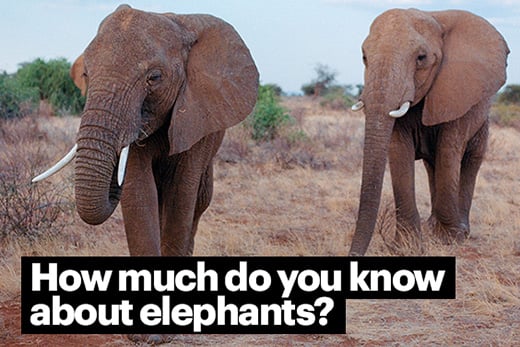 |
Two elephants in Samburu National Reserve, Kenya. Photo: Teti Sulu / © IFAW |
Elephants are one of the most awe-inspiring animals to walk the earth. They’re also one of the most endangered.
How much do you know about the three species of elephants that you are helping to protect? |
African forest elephants, African savannah elephants, and Asian elephants. |
African forest elephants: Yes, both males and females have tusks, and they’re thin, straight, and point downward—unlike the curved tusks of savannah elephants. This helps them move through thick, forested areas.
African savannah elephants: Yes! Both male and female African savannah elephants have tusks.
Asian elephants: Some male Asian elephants have large, prominent tusks. However, most female and some male Asian elephants have small tusks, called tushes. Asian elephants also only have one finger-like extensions at the tip of their trunks, while African elephants have two. |
African forest elephants: African forest elephants can weigh anywhere between 8,000-10,000lbs.
African savannah elephants: African savannah elephants are the largest species of elephant. Adult males can weigh up to 15,000 lbs—even newborn African elephants can weigh as much as 200 lbs!
Asian elephants: Asian elephants are smaller than African elephants. Adult females weigh up to 8,000 lbs, and adult males up to 13,200 lbs. |
African forest elephants: African forest elephants are primarily at risk due to poaching and habitat loss.
African savannah elephants: African savannah elephants are largely endangered due to poaching but are also vulnerable to habitat loss and human-elephant conflicts.
Asian elephants: Asian elephants are endangered due to habitat loss caused by human activities such as agriculture, infrastructure development, and urbanization, as well as poaching and hunting. |
https://ifawnews.org/do-all-elephants-have-tusks |
- Get link
- X
- Other Apps

Comments
Post a Comment