A Holocaust scholar asks: 'Israel, what went wrong?'
A Holocaust scholar asks: 'Israel, what went wrong?'
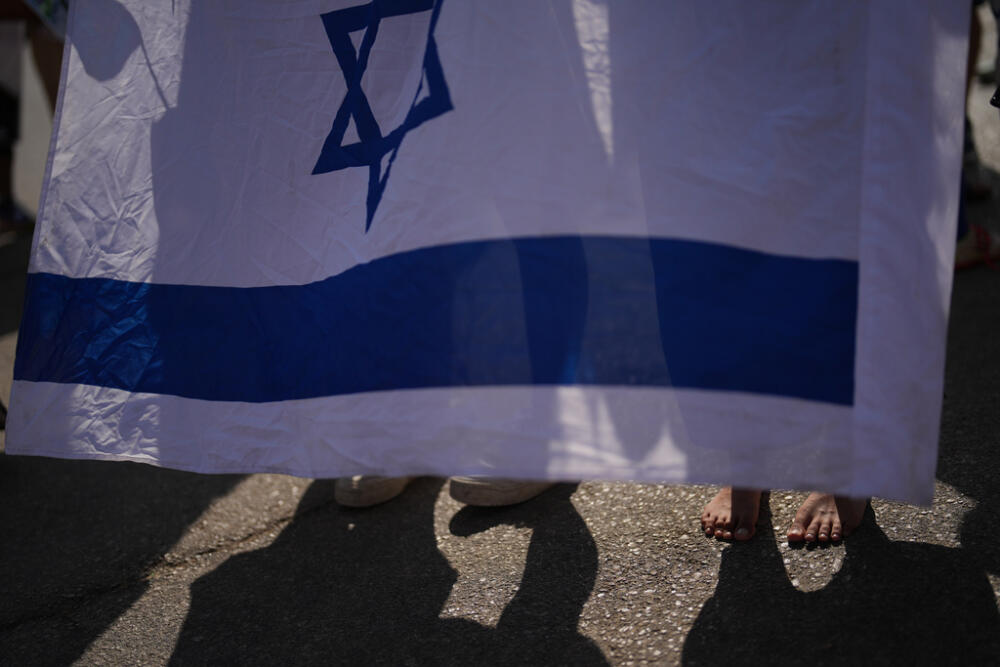
Omer Bartov was born on an Israeli kibbutz, grew up committed to Zionist ideals, and is now professor of holocaust and genocide studies at Brown University. But in his new book, Bartov argues that Zionism has changed and he can no longer support it.
Guest
Omer Bartov, Israeli-American historian. Dean's Professor of Holocaust and Genocide Studies at Brown University. His new book is “Israel: What Went Wrong?”
Transcript
Part I
MEGHNA CHAKRABARTI: Omer Bartov is a highly respected historian of the Holocaust. His many books include The Eastern Front, 1941 to 1945: German Troops and the Barbarization of Warfare. There's also Hitler's Army: Soldiers, Nazis, and War in the Third Reich; Murder in Our Midst: The Holocaust, Industrial Killing, and Representation; and Mirrors of Destruction: War, Genocide, and Modern Identity.
Support WBUR
He is the Dean's Professor of Holocaust and Genocide Studies at Brown University. Bartov was born on an Israeli kibbutz. He grew up in Tel Aviv, served in the Israeli Defense Forces. He says his father was a staunch Zionist, and Bartov's own early life was deeply informed by Zionism as practiced at the time.
But now, Bartov says Zionism has mutated into a form unrecognizable to him. He says Zionism of his youth is now an extremist regime that sanctions mass murder in Gaza, rising authoritarianism in Israel, and is creating a world that is less safe for Jews. His new book is Israel: What Went Wrong?, and he joins us.
Professor Bartov, welcome to On Point.
OMER BARTOV: Thanks so much for having me.
CHAKRABARTI: I'm wondering if we could start with your earliest days. Born on a kibbutz, as I said, but your boyhood was mostly spent in Tel Aviv, yes?
BARTOV: Yeah, correct.
CHAKRABARTI: So what was that like, and how did the Zionism of the time flow through your daily existence as a child?
The truth is that growing up in Israel, and I was born in the mid-'50s. In the late '50s, early '60s, we didn't really think of Zionism. We didn't actually think of being Jewish. We were Israeli. We were born, we were the first generation born in Israel after the establishment of the state, and we thought of ourselves as just part of that place, and we had a kind of vague Israeli identity.
In the late '50s, early '60s, we didn't really think of Zionism. We didn't actually think of being Jewish. We were Israeli.
Support WBUR
We knew that our grandparents were Orthodox Jews who came from elsewhere. Zionism was not really a term that was used very much, and the kind of environment that we grew up in, there were only Jews there. It was a relatively empty country, quite still making its way into modernity, so very provincial.
We were surrounded, however, by remnants of something else, and nobody really talked about it, so we used to play in ruined houses that were called abandoned property, rechush natush in Hebrew. And we knew that Arabs had lived there once, but there were vague statements that they fled during the war. And over time, these remnants of villages, of mosques, of cemeteries gradually got covered over, by parks or by new tenements for the large numbers of Jews that were arriving there.
CHAKRABARTI: But you also write in the book that the very fact of the existence of Israel there was due to several things, but the realization of a Zionist dream, right? For a safe homeland for the Jewish people.
And you also write that at that time, every family that you knew who had family members that had stayed in Europe, had been horribly touched by the Holocaust. Those were still very real and present.
BARTOV: Yes. When I think about it, I think that my generation, which was born after everything happened, it was born after the Holocaust, it was born after the war of 1948, it was born after the Nakba, which was the mass expulsion of the Palestinians.
We were born after all of that. That my generation was raised on two denials. One denial was the denial of where we came from, or our parents and grandparents came from, the diaspora. We were not supposed to look back at the diaspora. We looked only forward. We were the future of the Jewish people. We were the future of the state.
And the second denial was of the Nakba, of the expulsion. But of course, we were surrounded. The people who were around us, many of them walked around, if you went to the beach, you'd either see people with their sleeves all the way down, although it was very hot, or you'd see numbers tattooed on their forearms.
Most of my friends did not have four sets of grandparents. I was lucky, because my grandparents came to Palestine before the war, but most people didn't have all of their grandparents, and all families knew that those who stayed behind never came out, never returned. So there was this knowledge.
It wasn't spoken about a lot until the Eichmann trial, early '60s.
Support WBUR
CHAKRABARTI: It's interesting because Eichmann shows up a couple of times in your book, and we'll talk about that a little bit in terms of the lessons from the trial. But you write early in the book about how you might define Zionism of the time, or the type of Zionism that your father believed in.
And you define it as an appeal to humanitarianism, tolerance, the rule of law, and the protection of minorities, while also being a belief in the self-emancipation of the Jewish people. Is that how your father would have seen what Zionism meant to him?
BARTOV: Yes, definitely. And Zionism begins before he was born.
Zionism begins in the late 19th century. But at the time, about 80% of world Jewry live in East Central Europe. And they live in areas where there's a rise of ethno-nationalism, which is defining a state according, or a nation according to its ethnicity, and then identifying its territory and saying that territory belongs to that ethnicity, and there should be a state there.
And Zionism means that it's a response to the idea that Jews are not really welcome suddenly. There is the invention of the Jewish question. What to do with the Jews? And many of the Jews who live in those areas decide to leave, and they go to North America. Of course, the gates of immigration to North America closed down after World War I in the early 1920s.
Or they go to Europe, or they try to assimilate, or they become socialists and communists and join the revolution. But some of them, and increasing numbers of them, become Zionists, and they basically emulate the same idea that the Jews are also a nation. They're an ethnic group that should have a state of its own.
But they can't create that state where they live, because they're not wanted there. So they go to what they perceive as their ancestral homeland.
CHAKRABARTI: The 'not wanted there' part is very important, and you actually write quite extensively in the book because you write about Zionism also as being a direct response to the terrible antisemitism that went on for generations and generations. And rose precipitously, as you say, ironically because of the Enlightenment and later Industrial Revolution and modernity, where Jewish people actually became much more part of mainstream European culture.
That's actually for a separate conversation. There's so much in this book that we could talk about. But I wanted to raise that because there are a lot of ironies that you point out regarding Zionism and the creation of the state of Israel. But I wanted to ask you then that as you grew and you became a young man, you served in the IDF.
Support WBUR
And you write about how that service also opened your eyes to other aspects of what is the reality of the Israeli state. Do you have an example?
BARTOV: Yes. So first of all, I would say that even before my army service, just as a young teenager when I was 17 or so, the occupation that began in 1967 was then very young.
We are talking about 1970, 1971. And I belonged to a small group that used to protest against the occupation. We didn't really know much about it, but we would carry little posters that said, "Occupation corrupts." We picked up that slogan someplace. Of course, we had no idea how long it would last and how deeply it would corrupt Israeli society.
And then, yes, then I went to the army. I was very young. I served in the West Bank. I served for a year in Gaza and Northern Sinai. And as a young soldier, I started feeling that we were in a place where we were not wanted, and I wasn't sure why we were there. Gaza then had about 350,000 people. My battalion command was there.
I would go there quite often. They were living in derelict homes. We were bossing it over them, and everything was a bit strange.
CHAKRABARTI: You weren't sure why you were there? Wasn't it clear from Israeli leadership or even just the fact of the existence of the Israeli state that you were there in order to protect that very state?
BARTOV: No. Because we're very young. I was generally against the occupation. But I didn't really, I can't say that I was able to articulate that very well. But I remember this moment when I was patrolling an Egyptian town, Al-Arish which is in northern Sinai, which was then still occupied by Israel, and I was a platoon commander.
I was at the head of 30 men, and it was a hot late morning. We were walking in the sun. Everyone was behind their shutters. I could feel that they were looking at us. They were afraid of us. We were uncomfortable because we did not know whether anything would happen to us. And I had this distinct feeling that something was not right, that why was I there?
They were afraid of us. We were uncomfortable because we did not know whether anything would happen to us. And I had this distinct feeling that something was not right, that why was I there?
Support WBUR
So there was this inchoate sense that maybe temporarily there was still then talk about the occupied territories would be a sort of bargaining chip for peace with Arab countries. It was still an open question whether that would happen. And so you could explain it to yourself. But the actual sense of being an occupying soldier, that we did not belong to that culture, to that space, that we were outsiders, was quite distinct, even though I wouldn't pretend to be able to, at the time, that I was able to articulate it very clearly to myself.
CHAKRABARTI: So the Zionism that rose in the early 20th century, then leading to the establishment of the state of Israel, we just have a few seconds before our first break, professor. But how far away from that Zionism would you describe current Zionism as it is believed in or espoused in Israel?
BARTOV: It's a world apart.
It really is a world apart. And that's why I dedicate my book to my late father, and I call him the last Zionist, because the Zionism he believed in had humane aspects to it. It sought social justice. It sought political justice. And the Zionism we see now is something very different. It's religious, it's messianic, and it's extremely violent.
The Zionism [my late father] ... believed in had humane aspects to it. It sought social justice. It sought political justice. And the Zionism we see now is something very different. It's religious, it's messianic, and it's extremely violent.
Part II
CHAKRABARTI: Professor, in the book, you write clearly, just quoting you here, you say, quote, "I am not anti-Zionist. I grew up in a Zionist home. I'm not opposed to the existence of the state of Israel. But Zionism is an ideology that didn't just run its course. It became something I don't recognize. It became the ideology of the state." So describe to me more in detail what that ideology is now.
BARTOV: Yeah, let me first say, when I say I'm not an anti-Zionist, there's meaning to that. Zionism began as an assertion that Jews have a right to self-determination, and I'm not opposed to that. I only think that one has to be consistent. If you believe that the Jews have a right of self-determination, then you believe in the idea of self-determination.
It's not only for Jews, it's for everyone. The Jews picked it up from other nations around them that began this process. Now, nationalism has many negative sides to it, and I don't particularly like nationalism, but we live in a world of nations, and we don't want to be stateless. It's not a good state to be in.
Support WBUR
So I don't say I'm an anti-Zionist, because I believe the Jews have that right, and I believe the Palestinians have that right. What I don't think is that you have the right to self-determine through oppression of others. It does not give you that.
I don't say I'm an anti-Zionist, because I believe the Jews have that right, and I believe the Palestinians have that right. What I don't think is that you have the right to self-determine through oppression of others.
So from that point of view, Zionism was an idea of somehow trying to find a place, a shelter, a safe haven for Jews who were increasingly persecuted in Europe, where they lived. And in many ways, it provided that, especially in the 1920s and '30s, when hundreds of thousands of Jews found place in Palestine, and those who remained behind, such as most of my family, on both my father's and my mother's side, were murdered. But as Jews were coming into Palestine, they also started acting as all settler colonial movements do.
They started encroaching on the land of the people who were already living there. Those were Palestinians and they had been living there for many generations. And so that created the conflict between Jews who were coming believing they were coming to the ancient homeland and the people who were living there.
That meant that Zionism had these two faces. It had a face of rescue, and it had a face of the beginning of encroachment, of violence, of friction between the two groups. And in 1948, there was a moment when the state had to decide. Zionism had accomplished its goal. It had created the Jewish majority state.
80% of the people who were in what became the state of Israel were Jews, 20% were Palestinian. They were only 20%, because the rest were ethnically cleansed. And the state had to decide what kind of state will it be. Will it be a state that would be just towards all its citizens? Would it be a state that would be able to somehow reconcile also with those it had expelled and those it was now ruling over, who were not Jewish?
That is, could it be a Jewish and democratic state? And it never made that decision. It promised to have a constitution that would reflect all these principles. It never issued that constitution.
CHAKRABARTI: We will talk about that later because it's a part of this history that I didn't fully realize until I had read about it in your book, so hold that thought for a moment.
But this is why there's a sentence that you write which I think is simple but profound at the same time, because all of this is happening, again, I don't need to tell you this, with the backdrop of the Holocaust. And so you say in the book that the Holocaust and the Nakba are intimately intertwined, that you can't actually consider one without the other, and why is that?
Support WBUR
BARTOV: You know, I'm not interested in comparing the Holocaust and the Nakba. These are two very different events, but they are inextricably linked, and they are linked historically. Because the Holocaust ends in 1945, the Nakba happens in 1948, only three years later. They're linked personally, because so many of the people who fight in the war of 1948, so many of the Jews who are in Palestine during what Israel calls the War of Independence and what Palestinians remember as the Nakba, are people who came from Europe, are people who either were survivors or whose families survived or did not survive or were murdered.
And they're linked together because both these events become the building blocks of a national identity for both groups. And because the groups are completely intermixed, because Jews and Palestinians, whether they like it or not, willy-nilly, are living right next to each other, their constituent moment is the moment of their catastrophe. For the Jews, it's the Holocaust. For the Palestinians, it's the Nakba.
CHAKRABARTI: So this is where these two lines of thinking come together, I see, in your book about how upon the establishment of the state of Israel, Zionism becomes a philosophy of the state, which is different than a philosophy of self-liberation.
And then again, the time period, it is what it is, but it's also critical because the living memory of the Holocaust is there, and so as you write, it provides right there and then, 1948, this justification, or let's say not justification, but a mental belief, which I think is entirely understandable, that the Jewish state, that Israel had to do what it had to do, causing the Nakba for Jewish survival, right?
Do you see what I'm saying? That it may be unpleasant to say the least, but putting myself, I'm not Jewish, but putting myself in the shoes of the Jews at that time, I can't see how that doesn't make intrinsic sense.
BARTOV: Yes. Look, first of all, After the Holocaust, there's a sense among Zionists, of course, but also increasingly in what is then the international community that a Jewish state should be established.
That there's a kind of logic that had there been a Jewish state, more Jews would've been saved, and there was no state to represent them, to protect them, to provide them shelter during the Holocaust. And so the notion that the state was the answer to the Holocaust is quite widespread. But the creation of the state is based on the notion that the Jews should be a majority in their state, that was the problem.
That was the origin of the Jewish question, was the Jews were a minority, so they have to be a majority. And so Zionism wants to create the Jewish majority state. The problem is that the masses of Jews that were supposed to come from Eastern Europe and to make Israel into a Jewish majority state have been murdered.
That was the origin of the Jewish question, was the Jews were a minority, so they have to be a majority. And so Zionism wants to create the Jewish majority state.
Support WBUR
They don't exist anymore. And in Palestine, in 1947, when the UN provides on the 29th of November, 1947 the Partition Resolution and suggests to create two states, a Jewish state and an Arab state, at the time, in Palestine, mandatory Palestine, still ruled by the British, two-thirds of the population are Palestinian Arabs, and only a third are Jews.
So how do you create a Jewish majority state when you have not the masses who would come from overseas, from the diaspora? They've been murdered. And so the process that creates that is very violent. During the war of 1948, while Israeli militias are fighting Palestinian militias and then the Israeli, the new Israeli army is fighting Arab armies, 750,000 Palestinians are kicked out, are expelled, are driven out very violently, often in cases of massacre.
And then there is this moment, there's this sort of zero hour. Now the state has been established, and the state says, "We will provide equality to all Israeli citizens, no matter their religion, their race, their ethnicity. Everyone will be equal." That's what it says in its proclamation of the state. It also says, "We will issue a constitution that will reflect the principles of that declaration," and that's never done.
It never happens. And immediately, as the state is established, it imposes military rule over those remaining Palestinians. There are now about 150,000, now 2 million, who remain in the state, who are Israeli citizens. Are subjected to military rule for the next 20 years. And the Palestinians who have been expelled are never allowed to come back in any form at all.
CHAKRABARTI: So I want to take a step back here and return to the sort of mental and philosophical change in Zionism. Because another thread in your book is that you characterize modern Zionism as a way of thinking in which the preservation of the Israeli state is so paramount it should come at any cost to others.
We will get to the trauma of October 7th in a few minutes. But I actually just want to have you tell us a quick story in terms of how that plays out in the lives of the young men and women who are serving in the IDF right now. Because you tell a story about how just a couple of years ago you were scheduled to give a talk in June 2024, at Ben-Gurion University.
And actually, the talk was about whether U.S. campus protests were antisemitic, but you were met with protests there as well. And ultimately, you and your fellow panelists decided to invite the young people who were protesting in to have a conversation, and you found out that many of them had just returned from service in Gaza.
What did they tell you? Can you tell us that story?
BARTOV: Yes. So this was at Ben-Gurion University in Beersheba, and as I was coming there, there were these young men and women. I thought that they would come to my lecture, but it turned out they were not coming to my lecture. They were standing outside with a bullhorn and banging on the walls, and eventually we invited them in.
Support WBUR
What they were shouting much of the time was, "We are not murderers." And they believed that I'd already stated that what Israel was carrying out in Gaza was genocide. I actually hadn't said that yet, but they already foresaw that I would. And so the most important thing that they were saying, "We are not murderers," which to me itself was a very sort of telling kind of statement.
They believed that I'd already stated that what Israel was carrying out in Gaza was genocide. I actually hadn't said that yet, but they already foresaw that I would.
We invited them in, and I sat with them for a couple of hours and talked with them. They were very angry. They appeared to me, many of them, to be suffering from PTSD. They had seen a lot of violence And it obviously perpetrated a lot of violence, but they were trying to show me two things, I think. One is that they were humane, that they were good human beings.
They were showing me photographs on their phones that they took of children, the children in Gaza that they had been giving food to. They said, "There's no hunger there." They showed me that they were giving them their own army rations. They showed me a picture of a girl who'd been wounded, and they said, "Look, we gave her all our medical supplies."
They didn't talk about how she was wounded, of course. So they wanted to show they were humane. At the same time, they wanted to explain to me that they had no choice but to obliterate Gaza, and that this was a matter of survival. That no one there was uninvolved, that everyone there was somehow connected to Hamas, that everyone there ultimately wanted to destroy Israel, and so that the only choice they had was to wipe the whole thing out.
And that kind of balance between the two was disturbing, of course. To me, as you said earlier, I'd studied the German army in World War II and the mentality of German soldiers at the time who were perpetrating massive crimes in the Soviet Union. About 26 million Soviet citizens died. It's usually not mentioned in American discourse about World War II.
And they were killed mostly by German soldiers. I started thinking about the similarity there, mental similarity, that people both see themselves as victims, right? We were victimized by them. It was Hamas that attacked us and murdered our people. We are under the shadow of the Holocaust. That is what Hamas did with the largest killing of Jews that was said in Israel since the Holocaust.
So we have to retaliate because this is like a potential holocaust. And at the same time, so we don't have a choice, right? And at the same time, we are so much more humane than they are. We would never do to them what they did to us, and so what we are doing to them is justified.
CHAKRABARTI: And this is, and you say in your book that closely mirrors the kind of mental preparation in Germany that took place, such that German soldiers could commit Nazi atrocities.
Support WBUR
BARTOV: They could commit them and they would attribute them to the enemy.
CHAKRABARTI: That they had no choice because of the actions of the quote-unquote, enemy?
BARTOV: Yes, because they were, first of all this, in German history, this goes back to the stab in the back in 1918. Why did the German army collapse in World War I? Because it was stabbed in the back by the socialists and the Jews.
And so in World War II, we don't want to be stabbed in the back again. So we were the victims. We were those who were victimized, and now we have to make sure that we're not victimized again. And because we carry out what we know are atrocities, we know what they will do to us if we don't finally finish them all off.
CHAKRABARTI: But professor, you know that there are many people hearing this right now who immediately would say, "It is unconscionable for Omer Bartov, Holocaust historian, though he may be, to even begin to draw connections between the actions of the Israeli Defense Force and the German army that obliterated the Jews. Or in this case that you're talking about the Soviets as well, in the Second World War, that these are, it is unconscionable that you would even dare to make that connection."
BARTOV: Yeah, so what is so extraordinary about this is that this connection is constantly being drawn in Israel. The entire discourse in Israel, and obviously most people don't listen to the Israeli media if they live in the United States, but if you do, which I do a great deal more, more than I'd like to. In Israel, Hamas are described as Nazis.
What they try to do, and the massacre of October 7th, is described as a potential Holocaust. The entire discourse in Israel --
CHAKRABARTI: It was the largest killing of Jews since the Holocaust, though.
BARTOV: We don't know that for sure. Maybe. There were many pogroms, very bloody pogroms after World War II.
Support WBUR
At least 1,500 Jews were killed in Poland after World War II. That's not, one can quibble with that, but that's not the main issue. The main issue is the term the Holocaust. When you say this is the largest killing of Jews since the Holocaust, it's a invocation of the Holocaust and the Nazis, and that's precisely the kind of discourse that you hear in Israel all the time now.
Hamas are the Nazis. There are no uninvolved people there, and therefore, we have license to obliterate them all.
Part III
CHAKRABARTI: You actually do draw several comparisons multiple times in the book between your scholarship on Nazi Germany and the German army, and things that Israeli leadership has been saying since October 7th.
And there's one that really stood out to me because you say that in 1941, there was a German army propaganda leaflet, and this was also in Hitler's campaign against the Bolsheviks at the time. And there's a quote in that leaflet that says, "We would insult the animals if we described these mostly Jewish men as beasts."
And then just a little bit later in your book, you say that on October 10th, so three days after the attacks of October 7th, the wife of Prime Minister Benjamin Netanyahu, Sara, went on a radio interview and said, quote, "I don't call them human animals because that would be insulting to animals." Very jarring, but words are different than actions.
So what I want to understand from you now, Professor, is why is it that more recently you have chosen to call what has happened in Gaza a genocide?
BARTOV: Because obviously that is very hotly debated. Sara Netanyahu officially does not have executive authority. She's the wife of the prime minister, although in Israel many people claim that she is the sort of spirit behind him.
But officially she has no executive power. But Yoav Gallant, who is the minister of defense, was then, not only had executive power, but also had a great deal of prestige. He was a general. He had served in elite units. And he, the day after October 7th said, "They will have no water. They will have no food. They will have no power. They are human animals, and they will be treated as such."
Support WBUR
Now, when the minister of defense says that, while Israel is recruiting hundreds of thousands of reservists, right? That's how the Israeli army operates, over 300,000 reservists who look up to this man, and they hear that they're human animals and they should be treated as such.
That coming from him can be seen as incitement to violence.
CHAKRABARTI: But that's not genocide.
BARTOV: No. So when you talk about genocide, if you look at the definition, the UN definition of genocide from 1948 in the Convention on the Prevention and Punishment of the Crime of Genocide, which is the only definition that matters under international law of what is genocide.
Genocide are acts carried out with the intent to destroy a particular group, an ethnic or racial, religious group, in whole or in part as such. So in order to identify genocide, you have to do two things. You have to see that intent has been shown and that intent is being implemented. So statements of intent were made immediately after October 7th, and there were many people who said these were statements made in the heat of the moment.
People were outraged by the massacre of 800 civilians. So maybe they were irresponsible because a prime minister or a minister of defense should not speak that way, but we can understand it. And then the other way to determine whether genocide is happening is a pattern of operations.
That's what the International Court of Justice has said, because mostly, most regimes engaged in genocide don't say they're doing that. They say something else. They say, "We don't have a choice." They say, "It's actually a war. It's not a genocide." So they have some other rhetoric. In this case, there was actually genocide, the rhetoric, which is rare.
If you look at the pattern of operations, and that's what I started doing by May of 2024, because you will remember in November '24, '23, I wrote an op-ed in The New York Times, and I warned, I said, "Look, there is evidence that there are war crimes and potentially crimes against humanity." About 10,000 people had already been killed in the first four weeks of Israel's campaign in Gaza.
By 2024, by June or May of 2024, you could see a pattern of operations, which was deliberate destruction of the Gaza Strip. And making it uninhabitable for its population.
Support WBUR
CHAKRABARTI: And that's one of the aspects of the definition of genocide, right? Deliberately inflicting on a group conditions of life that are calculated to bring about its physical destruction.
By that, so when you saw that pattern of action, that's what made you decide to call it a genocide. But of course, as far as I understand, another aspect of the formal definition of genocide is that the intent and action also have to be to destroy this particular population wherever they are, which is, that's what happened during the Holocaust, right? It wasn't just limited to Jews in Germany. And many people who staunchly defend Israel would say, just by that one factor alone, it's impossible for this to be considered a genocide.
BARTOV: So what you're saying is what many people say, which is if it doesn't look like the Holocaust, it can't be a genocide.
CHAKRABARTI: Because the Holocaust is, you used this word, uniquely evil in its destruction of a people.
BARTOV: Yes.
CHAKRABARTI: Did it set too high a bar, is what you're saying?
BARTOV: The bar is not the Holocaust. That's our point. So the Genocide Convention, obviously, when it comes in 1948, the same year that the State of Israel is established, comes in the wake of the Holocaust and many other crimes committed by the Nazi regime.
As I said, millions of other people were killed who were not Jews, and were murdered in genocidal actions by the Nazi regime. So in 1948, because Raphael Lemkin, this Jewish Polish lawyer who ends up in the United States, whose whole family is killed in Poland, comes up with the term and manages to persuade the United Nations of this concept of genocide, the attempt to destroy a particular group, not necessarily many people.
It includes killing many people, but the intent is to destroy the group as a group. He persuades the UN to pass that resolution and that convention is what defines genocide, not the Holocaust. The Holocaust is a genocide. It had many unique features to it, but generically, it is a genocide, and each genocide has different characteristics.
Support WBUR
As long as they are, you can identify them as similar to each other by the attempt to destroy a group, in whole or in part as such. That is what Israel tried to do in Gaza.
CHAKRABARTI: Yeah. So but let me ask you, because we've had guests on this show who say, from Israel, who have told us, "We don't intend to destroy all Palestinians in Gaza," but they will go so far on, I've heard on this show as to say, "But we just don't want them to live in Gaza."
BARTOV: Exactly. So what Israel tried to do --
CHAKRABARTI: And but they would say therefore, it's not a genocide.
BARTOV: What Israel tried to do in 2023, 2024 is what it did in 1948, and people spoke about it in Israel in '23, '24. That is to ethnically cleanse them. People said in 2023, "This will be the Gaza Nakba."
That's the term that was used. So what Israel tried to do, because Netanyahu's previous policy of managing the occupation didn't work out, because there was a huge attack by Hamas, what was the other option if you don't manage it? Ethnically cleanse them. The problem was that unlike in 1948, the Palestinians had no place to flee to.
In '48, they fled to Jordan, to Lebanon, to Syria. The borders were open. In 2023, the borders were closed. Most of the border of Gaza is with Israel. Obviously, Israel didn't want the Palestinians to flee into Israel, and the border, the very narrow border with Egypt was also closed.
So what was indeed the intent originally, which was to ethnically cleanse the Palestinian, to kick them out, as happened in '48, became a genocidal operation, and that's typical of genocide. That happened in 1904 in German South West Africa. It happened with the Armenian genocide. In fact, that's how the Holocaust begins. The Holocaust begins with Germany wanting to be rid of its Jewish citizens. It doesn't want to kill them. It want just them leave, and then it goes to Austria, and it wants the Austrian Jews to leave, and then it goes to Czechoslovakia and wants them to leave, and eventually, as it expands, it's controlling more and more Jews, and there are fewer and fewer places to which they can go, and it comes to control millions of Jews, and then as the Germans say in their own peculiar manner, then the most humane solution to this issue is to kill them.
So it begins as an idea of removal of population. That's what Israel would have liked to do, and Prime Minister Netanyahu spoke about it openly in May of '25. He said, "They have no homes to come back to. We've destroyed their homes. Our only problem is to find countries that will take them in."
Support WBUR
So it begins as an idea of removal of population. That's what Israel would have liked to do, and Prime Minister Netanyahu spoke about it openly in May of '25.
He didn't find those countries. Those people are still there. There are two million people there. There are at least 73,000 that were killed. That's what the IDF itself now has conceded is the figure, but the numbers are likely much higher than that.
CHAKRABARTI: We're running out of time rapidly, professor, much to my heartbreak here, but so I have several more questions to get through in the next five or six minutes, and one is, as I was reading your book, I kept imagining, in fact, reading like other Israeli thinkers who disagree with your position on genocide in Gaza, and one line of thinking that kept popping to my mind is that people often say Israel is held not only to a double standard, but a higher standard, right? That somehow the Jewish Israeli people are expected to not act on the trauma of the Holocaust or to hold back on the military's actions after the attacks of October 7th.
They're supposed to find political solutions to the threat of being surrounded by hostile states that have said repeatedly they would like to see Israel wiped off the face of the map. And perhaps even you in your book are holding Israelis, Jewish Israelis, to a higher standard, and why?
I guess that's what they're wondering.
BARTOV: So I'll say two things. First of all, the assumption that all the countries surrounding Israel want to destroy it is false, and it's just an Israeli propaganda statement. Saudi Arabia has already proposed peace with Israel 20 years ago.
Egypt and Jordan have peace with Israel. The Gulf States want to have peace with Israel. There's only one problem, that Israel refuses to settle the issue of the Palestinians, and one has to remember, Israel is one state.
CHAKRABARTI: You didn't mention Iran, interestingly enough.
BARTOV: No. Iran is not an Arab state.
Support WBUR
CHAKRABARTI: Okay. Fair. That's fair.
BARTOV: We are talking about Arab states. It's a Muslim state, but it's not an Arab state. And Iran is the enemy of all those countries, of Saudi Arabia, of the Gulf States, and so forth. The main problem is that between the river and the sea, between the Jordan and the Mediterranean, there's really only one state, and there are 14 million people living there.
Seven million are Palestinian Arabs and seven million are Jews. And the Jews are ruling over the Palestinian Arabs. Two million of them have limited rights as citizens, but not the same rights, and the rest, the other five million, have no rights at all. That is an issue that Israel has refused to face up to, so that's one thing that we really have to make clear.
But the other issue on exceptionality, what is exceptional, and what people refuse to acknowledge, since 1945, there were many genocides and there are many horrible regimes around Sudan and what Russia is doing in Iran and in Ukraine, and Myanmar and so forth, and what the Chinese are doing to the Uyghurs.
There are many terrible regimes. But the only difference is that the State of Israel, for two and a half years, carried out an extremely violent operation in Gaza with the support, not only impunity, but with the support of the very countries that have always claimed to be the protectors of international and human rights, European countries and the United States, who not only didn't stop it, but provided it with military, economic, and political help.
That has not happened since 1945, that a state was assisted in carrying out genocide.
That has not happened since 1945, that a state was assisted in carrying out genocide.
CHAKRABARTI: Yeah. And you write in the book, at the end of the book, very clearly that you believe the only thing that could truly change the trajectory that you see Israel being on is the United States. We could also talk about that for quite some time, but we only have two minutes left here, professor, so two questions.
One is, what are your concerns or your fears for the State of Israel, if, again, this form of Zionism, as you have identified it, continues to be an animating force in Israeli government?
Support WBUR
BARTOV: I think if anyone cares about the State of Israel, which I do, I lived there half of my life. I have family and friends there, and I care about it also historically, and I think it should remain.
If anyone cares about it, the course on which it is now is leading it to the abyss. It will become a full-blown apartheid state. Whatever is left of democracy and liberalism there will be destroyed. The rule of law is being dismantled there, and that would make it into a real pariah state, and as such --
CHAKRABARTI: But does Benjamin Netanyahu care?
I don't think he cares at all.
BARTOV: No, he does not. He does not. So the only way to change that course, and mind you, there is no internal dynamic in Israel to change that. That change has to come from the outside, and the only actor who can make that change is the United States. The limits of Israeli power need to be returned to their natural place.
They should not be in Washington, D.C. They should be in Jerusalem. That will force Israel to find a different course to settle the core issue of its existence, which is the relations with Palestinians.
CHAKRABARTI: We only have a few seconds left. But in the book, professor, you say you do still consider Israel your homeland.
Do you feel estranged from your homeland?
BARTOV: I do feel estranged from my homeland, and I pray to God, although I'm totally secular, that the next election, if it happens in October, will remove this particular regime and will begin a slow process of reforming that country. For the moment, I can't see myself going there.
The first draft of this transcript was created by Descript, an AI transcription tool. An On Point producer then thoroughly reviewed, corrected, and reformatted the transcript before publication. The use of this AI tool creates the capacity to provide these transcripts.
This program aired on May 13, 2026.
https://www.wbur.org/onpoint/2026/05/13/holocaust-scholar-israel-what-went-wrong

Comments
Post a Comment