Inside Trump's self-dealing presidency
Inside Trump's self-dealing presidency
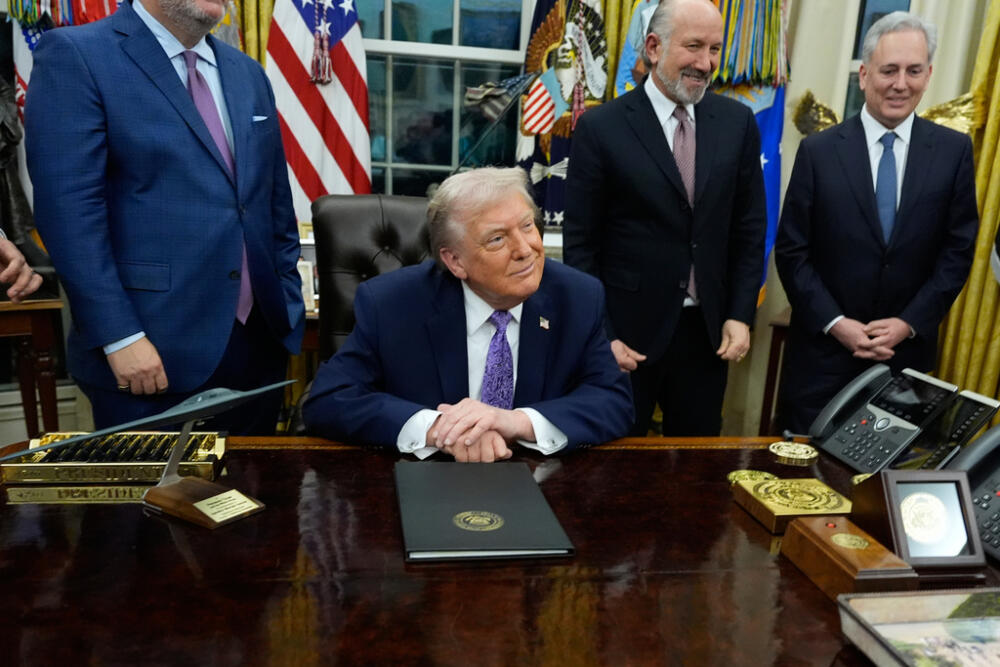
Since taking office, President Trump’s wealth has grown by at least $1.4 billion. There have been overseas real estate projects, a Trump phone that doesn’t exist and a Trump-branded cryptocurrency. Conflicts of interest or corruption?
Guests
Mitch Jackson, trial lawyer with 40 years of experience. He writes the Substack “Uncensored Objection. Law. Facts. No Spin.”
Gary Kalman, executive director of Transparency International U.S., an organization focused on combating corruption.
Support WBUR
The version of our broadcast available at the top of this page and via podcast apps is a condensed version of the full show. You can listen to the full, unedited broadcast here:
Transcript
Part I
MEGHNA CHAKRABARTI: In 2024, President Donald Trump's net worth was between $2.4 to $3.9 billion. Then he was reelected to the presidency. And in the one year and four months since he took office for the second time, that net worth has soared to between $6.5 to $7.3 billion.
STEPHANIE RUHLE [Tape]: It is time now for Money Power Politics, and as the Iran war enters its third month, we are once again asking the question that I ask almost every night on this show: Is this White House for sale?
According to Bloomberg, the U.S. Air Force has now agreed to buy an undisclosed number of interceptor drones from a company called Powerus. But you can guess — can you guess? — who just happens to be major investors behind this company? The company is backed by none other than the president's two eldest sons, Eric and Don Jr.
JACQUELINE ALEMANY: Trump's lawyers are trying to reach a settlement with Trump's IRS, overseen by Trump's Treasury Secretary, to pay out millions of dollars, if not more, of taxpayer collected funds into Trump's pocket.
Support WBUR
AARON PARNAS: 590,000 buyers paid $59 million to buy the Trump phone that was advertised by the president and his family. Not a single Trump phone has shipped to date. These folks may never get it.
LIZ OYER: Donald Trump has been granting pardons to people who have defrauded and cheated others to get rich. The pardons have the effect of wiping out the legal obligation to repay the debt.
Many of these people owe millions of dollars to their victims. They include Trevor Milton, who stole over $600 million from investors in his business; the Chrisleys, who owe over $22 million to banks that they defrauded; Michelle Fiore, who stole money from a police memorial fund and used it for plastic surgery...
KORVA COLEMAN: A nonprofit group is suing the Trump administration over its move to resurface and paint the reflecting pool blue on the National Mall. The group says there was no federal review of the plan, and the work is already underway.
JESSICA CRAVEN: The consultant who did the original estimate for the fountains told the Times they just took the cover page of my estimate and just added a bunch of money onto it.
CHAKRABARTI: The presidency has been good to Donald Trump's bank account, but not his alone. The Trump family grows ever richer, too.
MAJOR GARRETT: Welcome back to The Takeout. Thanks for hanging out with us. There are times when I see a lede of a news story that is so startling to me, I have to read it out loud. I did that earlier this week when I came across this piece in the Wall Street Journal. "Four days before Donald Trump's inauguration last year, lieutenants to an Abu Dhabi royal secretly signed a deal with the Trump family to purchase a 49% stake in their fledgling cryptocurrency venture for half a billion dollars."
CHAKRABARTI: And then there's this.
JEMELE HILL: The new Melania documentary has already been a financial success if your last name is Trump. Jeff Bezos and Amazon paid $40 million to license it. Melania Trump has already pocketed $27 million from this movie. It is an unprecedented move by a sitting first lady to profit off of access to her private life.
Support WBUR
CHAKRABARTI: Now, we could call this overt and unprecedented corruption, except that officially, President Trump has not faced any legal, ethical, or political consequences for his many dealings that seem to be in violation of the law. And they are definitely in violation of centuries of political norms.
But establishing a newly normalized pattern of corruption does have an impact on a nation as a whole, in everything from how the government is using and wasting taxpayer dollars to eroding the fundamental sense of fairness and transparency that a nation's civic and economic life relies on.
So today, we're going to look at this catalogue of corruption. How many of these deals are actually definable acts of corruption? And what are the laws and rules that have typically tried to curb political self-dealing and personal enrichment?
Mitch Jackson joins us. He's been practicing law for 40-plus years and has a Substack called Uncensored Objection: Laws. Facts. No Spin. And he joins us from Los Angeles.
Mitch Jackson, welcome to On Point.
MITCH JACKSON: Meghna, it's so good to be here. These are serious times, right? And the question is whether or not Congress is doing its job. So I think I'm really interested in joining you today because people are confused. They're exhausted. They deserve the truth, and that's why these types of conversations matter. So it's good to be here.
CHAKRABARTI: Well, I'm glad to have you. Okay, you just mentioned Congress right off the bat, so we're gonna start with a yes/no. Okay? That's all you get, counsel. Yes/no. Is Congress doing its job?
JACKSON: No, Congress is not doing its job.
"Congress is not doing its job."
Mitch Jackson
Support WBUR
CHAKRABARTI: Okay, now that we've established that, let's build our case here. And also, I have lots of questions about whether some of these things, some of these deals are just, maybe they feel icky, but they're not necessarily definable actions of corruption.
But let's start with one that's been receiving a lot of attention in the past couple of weeks, and that is the reflecting pool in Washington, D.C. Now, sort of broadly speaking, the reporting is that — well, actually, the president has actually said that he started off this process by looking at his own pools at his own properties and saying, "Hey, we can do better."
Here he is in the Oval Office just last month, talking about the Lincoln Memorial Reflecting Pool, and he describes a plan he worked on with Interior Secretary Doug Burgum.
PRESIDENT DONALD TRUMP: I said, "You know, Doug, I have a guy who's unbelievable at doing swimming pools up the road. We have a club. We have an Olympic-sized swimming pool. He did it 20 years ago, and it's perfect to this day." So I asked him, I said, "I have an idea. I'm gonna send my contractor over and take a look." He looked at it. He called me up. He said, "Sir, we can do something on it." He said, "It's perfect, actually."
CHAKRABARTI: Now, of course, that's totally normal if you're a private landowner and you're like, "Hey, I know this guy. Like, he can do your pool." But that's not how the government is supposed to work, is it, Mitch?
JACKSON: No, it's not. And that sentence that you just shared with your audience spoken by the President of the United States on camera is a confession of contract steering. Procurement lawyers will spend their entire careers trying to prove what Trump just admitted before lunch. It's not okay, and Congress needs to step in and fix this problem. But we both know that's not going to happen.
"Procurement lawyers will spend their entire careers trying to prove what Trump just admitted before lunch."
Mitch Jackson
CHAKRABARTI: Okay, contract steering. Now, how does that step away from the normal process of the awarding of a federal contract for something like improvement of federal property? I mean, the first thing that jumps out to me is, like, I think the government is supposed to try to seek out the best cost contract. They're supposed to try to minimize spending, at least have more than one bidder.
JACKSON: Absolutely. There's a thing called the Competition in Contracting Act, and what it says is that federal contracts must be open to bidders, and the whole point is to keep presidents from picking their friends.
Support WBUR
There are narrow exceptions to these contracts: natural disasters, wartime, things that can't wait. But the emergency here, building this pool, painting it blue in time for the president's birthday party, is not an emergency, and that's the problem here. There's no new facts that we didn't know last year, the year before, five years ago, that are present today that would constitute an emergency.
And so this is the typical play that we're seeing with this administration for sidestepping or avoiding their constitutional requirements. There's also what's called the Federal Acquisition Regulation that talks about contracting officers must avoid even the appearance of a conflict of interest. What you just played, to me, and I think to most Americans, signifies, you know, a blatant appearance of conflict.
But conflicts of interest are what this presidency seems to be all about. And I'm not sure we're going to see any changes in the near future.
CHAKRABARTI: So avoiding even the appearance of a conflict of interest. Is that in the law, or was that just customary in terms of how contracts were awarded? I'm just wondering if indeed this is — is this indeed a definable act of corruption according to what federal law is?
JACKSON: Well, it's only going to be deemed an act of corruption if Congress acts. And in order for Congress to act, there's going to have to be three things that take place. And I think we both know this isn't going to happen. But just so your listeners understand, Congress has the ability, three things, okay?
Oversight, they can investigate, they can subpoena, they can hold hearings, and they've had that power since 1927. The second power they have over the things that we're talking about today is the power of the purse. Under Article 1, Section 9, every federal dollar runs through Congress, and so they can shut off any contract, any settlement, any program that they want to tomorrow morning.
And then we also have the separation of powers. Way back in 1952, Justice Jackson talked about how if Congress stays silent, presidential power expands. Silence is not neutrality. Silence is permission. So to answer your question, unless Congress takes action to either stop, pause, or rein in the type of conduct that we're talking about right now, there isn't a designated violation or breach of the law that, for example, the president or anyone else acting could be found liable for.
Now, this could all come back full circle after the midterm elections. If there's a new majority in Congress, there's new oversight, there's new power of the purse, there's a separation of powers that's enforced, then hearings can take place, then subpoenas can be issued. So this isn't a done deal, but between now and the November elections, it probably is.
CHAKRABARTI: It's yet another example of how much the sort of the small-D democratic and transparent presumptions of how our government has functioned for decades, if not centuries, relied not so much on the letter of the law, but on just the belief that people of good faith wouldn't do certain things.
Support WBUR
But the details as they've emerged about the reflecting pool get even more interesting, right? Because the, the person or the company that Trump had referred to turned out to be Atlantic Industrial Coatings. They had done some work on one of Trump's national golf clubs in, I guess the one in Virginia. But they've never held a federal contract before. They don't even advertise that they do swimming pools. They do other things, culverts, pipes, and roofs.
And here's — the thing is is that the original price tag was supposed to be, according to the president, a $1.5 million. But now I think the National Park Service has said it could rise to 13 million, Mitch?
JACKSON: Meghna, the price jumped 873% before the paint dried. And I think that's something that American taxpayers need to pay attention to. Like you said, it went from 1.5 million to the first contract raised up to 6.9 million, five weeks later, 6.2 million, all the way up to 13.1 million.
"The price jumped 873% before the paint dried."
Mitch Jackson
You know, there's no oversight as to how much spending is going to be taking place, and as you and I both know, and as you listeners know, this is just the start. There are additional contracts. There's additional costs that are incurred as jobs materialize. And that's why we have this ability and this need to have contractors checked and contractors send in bids, so that we make sure people coming in doing the job know how to do it properly. And that's not happening in this case.
Part II
CHAKRABARTI: Now, Mitch, I just wanna play one more thing about the reflecting pool because as you said, the president's been very open and honest in talking about how a contractor who's never had a federal contract was charged with, well, changing one of the largest and most historically meaningful places in the middle of Washington, D.C. So here's the president talking about how much the contract would cost back in April.
TRUMP: He came in — and remember, three and a half years, have to take all the granite out, then you have to put all brand-new granite in, take years to do it. Over $300 million. Our job will take one week and will cost about $1.5 million.
CHAKRABARTI: $1.5 million, which as Mitch and I discussed before the break, has now ballooned to $13 million at least, and could get even higher.
Support WBUR
So Mitch, actually, to be honest, even $13 million is like a molecule of water in the bucket of overall federal spending. So is it not so much the actual dollars that matters here, or is there a pattern of the president's behavior when it comes to self-dealing that this contract reveals?
JACKSON: I'm so glad you brought up the pattern, because I think that is the concern. It's something that needs to be reined in. You know, what people don't talk about and what we haven't talked about yet is the Lincoln Memorial is a National Register of Historical [sic] Places. Any changes to it triggers Section 106 of the National Historic Preservation Act, and that requires federal agencies to consult with the public and other agencies before altering the property.
And this administration completely skipped that consultation entirely. They skipped the environmental review by the National Environmental Policy Act, which is what it requires. There are two federal statutes completely ignored on the most photographed landmark in the country, and that's a problem.
It's a problem when you think to yourself, and take a deep breath, and I'd like everyone to pay attention, because if they can do this with the Lincoln Memorial and the reflection pond, they can do this with the Grand Canyon. They can do this with Yellowstone. They can do this with the Vietnam Memorial, the White House itself, you know? Geez, what would happen if somebody demolished part of the White House without all of these checks and balances?
CHAKRABARTI: Well, nothing. Nothing would happen. We know the answer to that.
JACKSON: Yeah, so it's a bigger problem than just the reflection pool, and that's one reason I was excited to be on with you today.
CHAKRABARTI: Okay. But Mitch, so but also the reasoning used here. I think you had mentioned this earlier, but let's get into this a little bit more.
Because the administration basically is claiming an exemption to the normal contracting process, right? Because they're saying there's apparently something called the urgent and compelling exemption, saying if they didn't, if they weren't allowed to act right now, a delay would result in serious injury or harm to the federal government.
JACKSON: Yeah, absolutely. But it's consistent with what we've been seeing in what I call the, the Trump five-step approach. Number one, he picks a project. Number two, he picks a contractor. Number three, the agency invokes what I consider to be, in my opinion, a fake emergency. "We need to get this done by July 4th," his birthday. Number four, the price multiplies two to five times. That's normal, what we're seeing. Number five, there's no competition, no public input, no environmental review, no congressional oversight.
Support WBUR
We're seeing these things over and over again every time there's a new project, and I think we're going to continue seeing it for the next three years unless there's a new Congress for the checks and balances that we talked about earlier.
"There's no competition, no public input, no environmental review, no congressional oversight. We're seeing these things over and over again."
Mitch Jackson
CHAKRABARTI: Okay. Well, I suppose some people listening to this could say, well, the example of the fountains is definitely ethically if not legally suspect, but the president himself, as far as we can tell, is not being personally enriched by this contract. So let's move to another example of really unprecedented behavior.
And it's one of my favorites, actually, if one can have a favorite act of possible corruption. But it is the president having his Department of Justice sue the IRS, currently operating under his presidency, for $10 billion over allegations regarding the president's tax returns. And these two parties that are operating under President Donald Trump are talking about settling. So he could actually make some money by suing himself and then settling with himself essentially.
JACKSON: Absolutely. And I actually see that happening before the end of the month, and I'll tell you why during this show. But we've got a situation where the President of the United States is suing the United States for $10 billion, and the lawyer defending the country, defending the United States, works for the president. I mean, that just feels wrong, it smells wrong, it tastes wrong, and it is wrong.
"The President of the United States is suing the United States for $10 billion, and the lawyer ... defending the United States works for the president."
Mitch Jackson
For the people listening that aren't familiar with this, just quickly, on January 29 of this year, Donald Trump and his sons, Donald Jr. and Eric, and the Trump organization, they filed a lawsuit in the Southern District of Florida against the Internal Revenue Service and the U.S. Department of Treasury. They're demanding about $10 billion in damages. That's in the paperwork.
Trump is the plaintiff. The defendant is the government, and that's the same government that Trump runs. The attorney general, who decides whether to fight him, was appointed by Trump. The check, if it ever gets written, comes from a treasury whose secretary serves at Trump's pleasure. That's what we're dealing with right now, and it's just blowing me away that people are even allowing this conversation to take place, because it's wrong and it shouldn't be happening.
CHAKRABARTI: It actually is remarkable and like you said, people are even allowing this conversation to take place. So I guess multiple times we're gonna go back to who's supposed to be the sheriff here? And it's Congress, yes?
Support WBUR
JACKSON: Absolutely. And that's the problem right now. You know, when you look at the $10 billion, which are his alleged damages, it's ridiculous because under 26 USC 7431, which is the law, the statute states that he's entitled to only $1,000 per unauthorized disclosure or actual damages plus punitive damages for willful conduct.
So to reach that $10 billion mark, you would need at least 10 million separate disclosures or actual damages theories that would tally up to that $10 billion in real harm. That's not here. It didn't happen.
And when you look at the other defenses to this case, which the Department of Justice probably won't raise because they won't have to, because they're going to be settling this case before the end of the month, and I can tell you why, these other defenses would probably result in this case being kicked out of court completely. But I don't see the DOJ raising them in this case.
CHAKRABARTI: Wait, so is that why you think it's going to be settled by the end of the month?
JACKSON: I think it's going to be settled by the end of the month because the trial judge on this case set a hearing between now and the end of the month for the Trump administration to come in, for the plaintiff to come in and the Department of Justice to come in and show that in fact there's a real controversy.
Under federal law, if there's no real controversy at issue, then this court doesn't have jurisdiction. And what that means is if the person who's suing is also the defendant, who also is in charge of whether or not the case gets settled or resolved, who's also in charge of whether or not a check gets settled, there's no real controversy, and for that reason, the case can be dismissed.
Also, there's what's called the statute of limitations. There's a two-year statute of limitations under 26 USC 7431(d) that basically says when something happens like this, you have two years to bring a lawsuit. This happened, and this lawsuit was brought well after that two-year period of time.
In any other case, the Department of Justice would come in and file a motion to dismiss because the two-year statute of limitation has run. I don't see them doing that in this case. I don't see them arguing there's no actual controversy in this case. And because they don't wanna allow themselves to be in front of the judge making these arguments, I do see this case settling before this hearing takes place.
CHAKRABARTI: Mm. Okay. (SIGH)
Support WBUR
JACKSON: (LAUGHS) There's a lot going on.
CHAKRABARTI: No, my sigh is only that sometimes I wish that we could do, like, I don't know, six to eight weeks of stories, each an hour long, about this stuff. But I guess that's why we have Substacks like yours, Mitch.
Okay, so let's move on. So that's the president actually using agencies within the government itself to possibly enrich himself.
Going back to contracts and then the way that the Trump family has actually really benefited from the handing out of government contracts. There's several DOD contracts that involve both the president's sons, right? There's Donald Trump, Jr. He joined a venture capital firm I think sometime in 2024, 1789 Capital, and that firm now actually has companies in its portfolio that have been awarded federal contracts, Mitch?
JACKSON: Yeah, absolutely. I mean, that's a broad statement because we're talking about contracts to produce drones, which would be used in the Iran war. We're talking about contracts that are bits and pieces of it are being put together by companies out of China. Eric Trump is in China right now with President Trump.
There's a lot going on. And so without that checks and balances that we talked about, we're seeing things that have never happened in history before via the president, via the administration, via the president's family, that in the past, when somebody owned a peanut farm, they sold it before they became president. When somebody, you know, had an oil company, they sold it when they became president, Bush I.
In this case, what we have is a situation where we've got an administration, a family, a president that's been enriching themselves from day one, in fact, before stepping into the presidency, at levels most of us would never have even imagined. But nobody's stopping it, and that's the part that gets under my skin.
CHAKRABARTI: Yeah. You know, correct me if I'm wrong, but if memory serves, when President Carter came to office, I think he put his peanut farm in a blind trust, which would be okay, right? Because he wouldn't have any dealings with the business of the peanut farm.
And the reason why I remember that is from the first Trump administration, Mitch, you probably recall this, he had this big press conference where people were saying, "Well, why don't you put the Trump company assets into a blind trust?" And there was this giant stack of 8.5 x 11 sheets of printer paper, like, they were several feet high, which I'm pretty sure were all blank. And he was like, "Here's the blind trust." I'm not even sure that ever happened in the first administration.
Support WBUR
JACKSON: Who knows, right? Nothing's being disclosed. There's no transparency. And what people need to understand is in the real world, the way it works is if you assigned your adult son to manage and control, if there was a blind trust, you can text your son, you can call your son, you can have dinner with your son. That doesn't impress me at all. It doesn't mean anything to me. Because in reality, without full transparency, we don't know what's going on.
And you and I both know that when you have somebody in the Oval Office who one week is telling America that his pool guy's going to be doing the fountain, and then several weeks later on Truth Social, he's posting, "I have no idea who this contractor is. Even if there are some mistakes, we're gonna take care of it," because apparently there are now some, some problems with the, with the construction that's taking place. Who's to believe anything that comes out of this administration and/or this particular president's mouth?
CHAKRABARTI: Yeah. I wanna go back to the contracts that are associated with both the president's sons. Because it's not just the potential corruption that I think Americans should be profoundly worried about, it's the material implications, right? There could actually be material harm done here. And here's why I say that.
So first of all, Donald Trump Jr., to just be more specific, it was 1789 Capital that he joined after his father won the November election in 2024. And since then, firms in this company's portfolio have received almost $750 million in federal contracts.
And then you had talked about the drones. There is a company called — let me get it right here. Do you remember what it's called? It's called Powerus. And both of the Trump's sons, Donald Jr. and Eric, are involved in this. It's based in West Palm Beach, Florida, obviously the home of Trump's International Golf Club. This is the thing that gets me. It was founded only last year. And the company has announced that it has struck a deal to sell an undisclosed number of interceptor drones to the Pentagon. That's what you were talking about.
The Trump sons are on the board of this company, and we don't know how much the contract is worth or exactly what the sales are going to be. But how can we be sure that a company only founded last year can deliver the kind of quality that we would expect if these are going to be, you know, used in American war fighting?
JACKSON: We can't, and that's the challenge. That's why we need competitive bidding. That's why we need full transparency. That's why we need — you could argue that the security of the United States of America when it comes to whether or not this technology's going to work and work correctly, are we contracting with the best companies who are building the best products for the best price that American taxpayers are paying for to do the job?
"Are we contracting with the best companies who are building the best products for the best price that American taxpayers are paying for to do the job?"
Mitch Jackson
I'm all for free enterprise. I'm all for open bidding. I'm all for making sure that everyone has a shot in America to do what they wanna do. That's what makes this country great.
Support WBUR
But when it comes to what you and I are talking about, what we're seeing, I mean, you could even translate this type of conduct more specifically over to the World Liberty Financial situation, where you've got Trump members — and we don't have to go there unless you want to — but you basically have the same type of scenario documented as to hundreds of millions of dollars going into the pockets of members of the Trump family.
And the United States is doing business and cutting deals with the same companies, the same people, the same players that are investing in World Liberty Financial. It's disgusting to see. It leaves a bad taste in my mouth, and I just don't think most Americans are aware of what's going on.
CHAKRABARTI: We have about a minute before our next break, Mitch. The World Liberty Financial story is actually very important, I think. Because part of it involves the United Arab Emirates, who gave World Liberty Financial some huge amount of money right before the president was inaugurated again on January 20, right?
JACKSON: Yeah, I mean, try $500 million four days before Trump took office, the foreign country's top intelligence official wired this money into a company half-owned by the incoming president's family. Not four months, not four weeks, four days before he took office, and that's not timing. I mean, that's not a coincidence, right? That's timing. And that's something people need to pay attention to.
"Four days before Trump took office, the [UAE's] top intelligence official wired [$500 million] into a company half-owned by the incoming president's family."
Mitch Jackson
CHAKRABARTI: Yeah, and I mean, I think the reporting is showing that the UAE wanted something in return, essentially, they wanted AI computer chips.
JACKSON: They certainly did.
Part III
CHAKRABARTI: Mitch, we've talked about the reflecting pool. We talked about the president's sons and their lucrative DOD contracts. We've talked about the IRS lawsuit.
Support WBUR
I spent a couple of days trying to look for as many examples as I could find, and if you just bear with me, I want to read, like, a fast lightning bullet point list of the other examples that I found. We don't have to go into them, but when you, when you hear them all together, the pattern is what jumps out, right?
JACKSON: Sure.
CHAKRABARTI: So there was a recent story about the Trump mobile phone, where some 600,000 Americans put a $100 deposit on this new mobile phone. And then this year, the Trump Corporation just changed the terms of service saying, "Well, this phone may never actually be made or delivered." Then the president is also suing his own Department of Justice for the fact of the Mueller probe from many years ago. He says it harmed his presidency, even though he wasn't president at the time.
There's the newly named Donald J. Trump International Airport in Palm Beach, Florida, where the Trump company controls all the products that are sold inside the airport. We haven't even touched the pardons, Mitch. Pardons of many people who donated directly to the president's campaign.
There's new reporting that the Department of Justice under President Trump may ask the Supreme Court to intervene on the guilty verdict that was levied against the president in the E. Jean Carroll case. There is — Oh, here's the one that's actually quite interesting, that the president's Truth Social media company, publicly traded, has the ticker DJT. He owns a huge amount of it in stock, and of course, the price of that social media company goes up and down directly related to the political proclamations the president makes.
Going back to the president's sons, they own a stake in a Kazakh mining company that has a $1.6 billion contract with the U.S. government. Then the Department of Justice has also announced a criminal investigation into two men, or they did announce a while ago, who were accused of stealing billions of dollars in a transnational crime syndicate. But two months after that DOJ announcement, those men were hired by World Liberty Financial.
That's just some of what I could find. Obviously, there's more. By the way, the UAE donation to World Liberty Financial, I think it gave them almost a 50% ownership stake in that company as well.
So again, Mitch, how would you characterize what the pattern is?
JACKSON: It's an exhausting pattern, just listening to you read through those highlights. You know, you circled back to the World Financial story, and you're right. It was almost half, you know, 500 million for half interest in the company almost.
Support WBUR
Here's what people need to understand. The man who signed that check, and this is before we roll into these other issues, is the foreign spy chief. He's not a private investigator looking for a good return. He is the UAE national security advisor and the head of intelligence services. The press in the Gulf calls him the "spy sheikh."
His day job is running espionage operations. His side project apparently is buying half of the American president's crypto company. And that's why it's so concerning to me. These other things that you talked about, I mean, the list goes on and on, and how long has he been in office in his second term?
CHAKRABARTI: 16 months. Almost 16 months.
JACKSON: We're just getting started. You know, you mentioned the Trump phone. I thought it was interesting how the terms of service were changed, and that does happen in private industry. Things happen. Things change. Things like this. But this looks very consistent with, you know, what we saw with his steak company, his water company, his airline company. "Made in America" was changed from the Trump phones to something like "made basically upon the principles and beliefs of Americans," right?
CHAKRABARTI: (LAUGHS) Yeah.
JACKSON: So as a lawyer, I'm reading between the lines. Heck, I'm not even reading between the lines. It's hitting me right in the face. And I'm like, "Come on, people. We're smarter than this. Get with it." But yeah, there's a lot going on, and we can touch upon any of those issues that are of interest to you and your audience.
CHAKRABARTI: Well, actually, they're all of interest to me, Mitch. (LAUGHS) But the time is running down, and I do wanna sort of link this to patterns of corruption worldwide, and again, so why this matters, right? We could talk about it 'til we're blue in the face, but ultimately, the American people, I think they know that it matters, but there are examples as to why.
So for that, let's bring in Gary Kalman. He's the executive director of Transparency International U.S. It's a group that focuses on combating corruption, and he joins us from Washington.
Gary, welcome to On Point.
Support WBUR
GARY KALMAN: Thanks for having me, Meghna.
CHAKRABARTI: I appreciate your patience, by the way, as we were going through many examples here with Mitch. So in your list, or your sort of index of corruption, how has the U.S. ranked, and how has that ranking changed?
KALMAN: Yeah, so the Transparency International puts out the Corruption Perceptions Index every year, ranking 180 countries on their levels of corruption. It pulls together from a variety of indices from experts around the world and comes up with a composite score.
The U.S. is now at 64 out of 100. So 100 is very clean, one would be very corrupt. So we're somewhere still above average, but sliding. In fact, over the last, 10 or 11 years, we've slid from a high of 76 in 2015 down to a 64 this year. So it's a concerning pattern and a downward trend.
CHAKRABARTI: Who else is in the 60s, Gary? Do you know offhand?
KALMAN: I'd have to go back and look.
CHAKRABARTI: Okay. I'm gonna look while I ask you the next question.
KALMAN: But-
CHAKRABARTI: But go ahead. Go ahead.
Support WBUR
KALMAN: Well, I will say this though. If you take a look at sort of our Western Democratic allies in Europe and such, we are below where most of them are. And so it's not sort of a territory that we're comfortable being in I would say.
CHAKRABARTI: Oh, it's interesting. So I've got it up here right now. We have Lithuania at 65, the Bahamas at 64, then comes the United States, Brunei. Under that, Chile, South Korea interestingly at 63, Israel at 62. So it's kind of a mixed bag there roughly in the middle.
But so let me ask you, when we look at, this is a perception of corruption index. Why does that matter that you're measuring the perception?
KALMAN: Well, you know, when you take a look at what's happening around the world, you could measure what are the laws in place and base your markings or your ratings on the actual laws. But as the conversation over the last 40 minutes or so has just proven that laws are only as good as the ability to enforce them. And so the index focuses on expert opinions. These come from the World Bank Index, the World Economic Forum, Freedom House, the S&P does an index.
So it is experts that are operating in these countries taking a look at what they see and what they are experiencing. And we feel that that's a better reflection of what's really happening in a country than a bunch of law — look, Nigeria has, I think every time there's a scandal, they create a new anti-corruption organization. There are over 30 anti-corruption oversight mechanisms in Nigeria. No one's gonna put Nigeria at the top of a anti-corruption list.
CHAKRABARTI: Well, okay, so you have actually jumped to something which I want to come back to in a minute about sort of that uprooting a culture of corruption is quite challenging.
Mitch, I'm gonna turn back to you in a moment, but Gary, is there evidence though that when the amount of corruption in a country, specifically from its leaders, rises, that that actually has a material impact on the nation and its people themselves?
KALMAN: Absolutely. If you take a look at the countries that are at the very top of the list or those at the very bottom of the list, you can see the impact that it has. And we know from other studies around the world that the rule of law actually is not just something that is a good thing to have. It actually has an impact on people's economic welfare.
And the countries down at the bottom of the list all struggle. And you have challenges in the healthcare sector, you have challenges in employment, you have challenges in wages, human rights, a whole variety of ways that people at the lower end of the spectrum are going to suffer because they're not in rule of law countries.
Support WBUR
CHAKRABARTI: Yeah. Okay, Mitch. So with that in mind, this is one of the reasons why I think actually fighting corruption has ostensibly, for a long time, been very bipartisan in this country. Because we can — let's think about infrastructure for a second.
I'm sure we can all think of some examples in other countries where corruption led to, you know, terrible public works projects going up, and actually even endangering people. The whole means of doing business in a corrupt nation becomes so problematic that, well, that country's economy just can't even operate as efficiently as possible. I mean, these are sort of basic rules on how to have, you know, a country continue to grow in a positive way.
JACKSON: Absolutely, and that's why I became a trial lawyer 40 years ago, is to take on the bad guys. And I think that's why it's really affecting me personally right now, is that I'm watching what's happening. And to Gary's point, that corruption index, when you start seeing this and start experiencing it and start accepting it as the norm, which I think a lot of people are doing, a lot of good people are accepting it as the norm because they don't know any better. They're being influenced by social media and different news stations, and they think this is just the way things are, and that's not the case.
And when you look at — I'd love to hear Gary's thoughts on this — when you look at what we're experiencing right now in the United States, how is that affecting our relationships around the world when it comes to trade, when it comes to trust, when it comes to support in battles and wars and things like this? This has many, many different impacts and implications other than just, you know, the economy, and I think that's something we need to be concerned with.
CHAKRABARTI: Hey, Gary, I'll let you answer that just quickly if you could, because there's a point about the culture of corruption I wanna investigate with both of you. But go ahead, Gary.
KALMAN: Yeah, I mean, this is real impact. And let me give you several examples.
I mean, there are examples of corrupt officials, you talked about bypassing the procurement rules and open bidding processes. When that happens, condos have been built with building inspectors turning a blind eye, builders not really paying attention to safety codes and collapsing and killing hundreds of people inside.
Right now, I'll give you an example that's moving through the United States Senate, is a bill that's supposed to regulate the cryptocurrency industry. That bill has extraordinarily weak and loophole-ridden provisions in it to protect against fraud and money laundering.
What does that mean for the average citizen? Well, if you're concerned about scams against grandpa and grandma, fraud scams that are gonna be committed through crypto that we've already seen are happening, this is not a theoretical, this bill does nothing to rein those in, or I should say very little. There are some, but very little.
Support WBUR
Or if you're concerned about the fentanyl crisis in communities around the country, the ability of Chinese fentanyl dealers to move fentanyl into this country and take their profits and continue to fuel their operations, there's very little in the way of catching money launderers. So this isn't, again, a theoretical, "Oh, we'd like everybody to just behave and not be corrupt." This has fraud implications, the drug problem, collapsing buildings. I could go on.
CHAKRABARTI: Yeah. Well, so with that in mind, I wanna expand our look beyond the president himself. Because, again, I'm also quite obsessed with this question of creating a culture of corruption and how that has an impact on the people of a nation.
In March of this year, the House Judiciary Committee was holding some hearings, and Colorado Democratic Representative Joe Neguse questioned then-Department of Homeland Security Secretary Kristi Noem about a $143 million no-bid advertising contract. It was given to a company called Safe America Media. Now, get this, the company did not exist just eight days prior to that contract being awarded. So here's a moment from that hearing.
FORMER DHS SECRETARY KRISTI NOEM: Is there a problem with this contract?
REP. JOE NEGUSE: I'll tell you about it.
(CROSSTALK)
NEGUSE: Madame Secretary — and then I'll give you an opportunity to respond. The company is registered to a political operative in Virginia. Do you know, just by way of example, whether this company that received $143 million in taxpayer dollars — has it ever done work for the government before?
NOEM: I don't know. I can't --
NEGUSE: The answer is it has not. And do you know why we know that? Because it was incorporated eight days, eight days before this contract went out. You want the American people to believe that this is all above board?
Support WBUR
NOEM: Yes, I --
NEGUSE: That $143 million of taxpayer money just happened to go to this one company that doesn't have a headquarters, doesn't have a website, has never done work for the federal government before, and is registered apparently or attached to a residence from a political operative? And of course, one of the subcontractors of that contract, as you know, is a political firm that's tied to you back when you were governor of South Dakota. The reason why I ask these questions is that this is taxpayer money.
CHAKRABARTI: Okay. Mitch and Gary, we only just have, like, a minute and a half left. And as far as I can see globally, whenever corruption gets to a certain point, it, you know, undermines an economy, as we talked about. It undermines belief in the rule of law and fundamentally trust between people and their governments, but also sometimes even between each other.
When the government is picking the winners and losers. Things can turn around. I mean, everyone's pointing to Hungary recently as a good example. But Mitch, I wonder, I mean, if Congress decided to act now through the, you know, not just legislative process or investigative process, but even just the power of the purse, we wouldn't even have to wait for corruption to get worse before we could get, make it better here.
JACKSON: And that's not going to happen with this Congress, and that's why the midterms are so darn important. I'll tell you right now, and I'm speaking as an independent, if the Democrats don't take a majority back in Congress in the midterms, this country's in serious — has serious problems ahead. That's how big of a deal this is.
People need to understand everything we talked about today, everything Gary talked about today, this is financed with our tax dollars that could be going to housing and education and food and everything else that we value as citizens, our everyday lives. Instead, it's going to all of this other nonsense. And we need to put a stop to it.
So yeah, this is a big problem, and the midterms actually might, you know, might dictate whether or not the country that we love, the country we live in moving forward, will be here over the next three years. That's how important Congress is.
CHAKRABARTI: Yeah, and corruption, I think, is one thing — I will still believe that amongst voters can bring together people of different political views because I think we all know it's bad for everyone.
So Mitch Jackson, author of the Substack "Uncensored Objection: Law. Facts. No Spin.," thank you so much for joining us today.
Support WBUR
JACKSON: Thanks, Meghna. I really appreciate it. Nice to meet you, Gary.
CHAKRABARTI: And Gary Kalman, executive director of Transparency International U.S., thank you so much for being with us as well, Gary.
KALMAN: Thank you for having me.
The first draft of this transcript was created by Descript, an AI transcription tool. An On Point producer then thoroughly reviewed, corrected, and reformatted the transcript before publication. The use of this AI tool creates the capacity to provide these transcripts.
This program aired on May 14, 2026.
https://www.wbur.org/onpoint/2026/05/14/trump-self-dealing-corruption

Comments
Post a Comment