B X Lee -- The End of the Age of Reason
The End of the Age of Reason
A Tale of Two Countries
The 250th anniversary of the birth of the United States as a nation, founded on Enlightenment principles, unfortunately marks a kind of end. I would call it the end of the Age of Reason. France, whose Bastille Day celebrations follow the Fourth of July by ten days, and which long considered America its partner nation in liberty, has lost its companion. It might have gathered other European nations to come together to subdue a bully by saying to Donald Trump: “Stop!” This may have been enough to halt his global economy-altering assaults on Iran, and to spare us our most humiliating defeat to date. But Europe is too polite and too deferential to the U.S. to do so (readers may recall how George W. Bush denigrated France, calling it “ungrateful” for not supporting our war against Iraq, after we saved them in World War II; what Bush neglected to mention was that we may not even exist as a country but for France!).
The near-bankruptcy that resulted from France’s support of the American Revolution led Louis XVI to calling the Estates-General of 1789, for the first time in more than 170 years. The Third Estate realized that, being 98 percent of the population, they did not have to subordinate themselves to the First and Second Estates (clergy and nobility, respectively), while bearing most of the tax burden. Through the Oath of the Tennis Court, representatives from the Third Estate declared itself the National Assembly, and the French Revolution began.
Earlier, the financial struggles that Britain suffered following the French and Indian War gave Parliament the idea of imposing the Stamp Act, and later the Tea Act, on its American colonies. “No taxation without representation” spread as a slogan, while Thomas Paine’s Common Sense became a bestseller. Following the Boston Tea Party, the First Continental Congress convened in 1774, seeking initially to petition the Crown for redress. When George III spurned every attempt, including the Olive Branch Petition, sentiment shifted to rebellion. The Second Continental Congress convened in 1776 and signed the Declaration of Independence—the document Benjamin Franklin carried to Versailles to enlist marquis de Lafayette’s support—and hence the American Revolution began.
The ancien régime fell because of its rigidity and fragmentation (no longer being able to perceive commoners as part of One)—which are core characteristics of disease—and in the case of Britain, actual madness in the king. There was an awakening to our natural rights, which was the point of the Lumières, or the Enlightenment. Now, what is lacking is the recognition of our right to mental health as the first wealth, or prerequisite possession, necessary to retain that recognition. The tyrannical forces know this and have waged psychological warfare (which is why America gave up its rights freely and enthusiastically, without the need for prisons or police), while the people do not even understand what is happening.
It has gotten to the point where, in the United States, reason no longer works, because we have lost our mental health, or the capacity for rationality that makes it viable. When a nation has lost touch with reality and its ability to reason, ideology becomes merely an excuse for self-destruction. In fact, we are barreling toward collective suicide in ways we have seldom seen in human history.
Reason is failing, not because of an intrinsic flaw, but because disease has affected it. We not only failed to prevent it but did not intervene, even as signs of advancing disorder raged on. As with an individual, the lifespan of an era can be truncated. Indeed, the potential of the era is very palpable and seemingly just within grasp, had the disease not taken hold. It is much like a young person dying, despite being gifted with great talent, full of promise, and apparently with a beaming future just a short while ago.
Like an individual, a nation can make wrong choices. The seemingly brilliant destiny of a young country was interrupted when it chose unhealthy habits, namely greed and short-sighted gain (neoliberal capitalism), a highly-imbalanced lifestyle (inequality), and neglect of parts of the body (turning a blind eye to misery) until there was extreme deterioration. It thought that abandoning principles—life, liberty, and happiness—would gain it an advantage, not knowing that identity and pride are life-preserving. Like individuals who are self-destructive, it kept believing that it was profiting, looking at partial numbers while neglecting the whole, becoming like cancer cells that do not recognize that they are killing the very organism that sustains them.
France, on the other hand, has lived through its own 9/11’s over more than ten years, with multiple major terrorist attacks; an ominous future with global warming, where temperatures have soared 25 degrees Fahrenheit above average but show no sign of stabilizing; and admission of vast numbers of the most traumatized refugees, which has resulted in incidents of violence like the country has never seen. Still, the institutions are holding, because the people are making the right choices. They have not allowed the fright of terrorist attacks to close off their freedoms; they have changed their lifestyles completely in response to global warming, turning into a “Nordic country” where all ages bicycle everywhere; and most impressively they have grown seemingly a half-foot taller than 25 years ago, looking much healthier, as they have held onto universal health care, unlike the U.K. or the U.S. (the latter never having started). Included in this is mental health, which appears to be helping them integrate foreigners into their society, too, in ways we have never succeeded in doing.
This era has shown that poor hygiene of the mind and soul generates fertile ground for a societal disease that culminates with mentally-impaired “leaders”, such as Donald Trump. He legitimized the bullying tactics of Russia, China, and Israel. He elevated Iran into a world power. And he—reflecting perfectly the psychoanalytic observation that the degree of pathology determines destructiveness, not personal claims (which is what we desperately tried to warn against)—ignited the start of endless world wars.
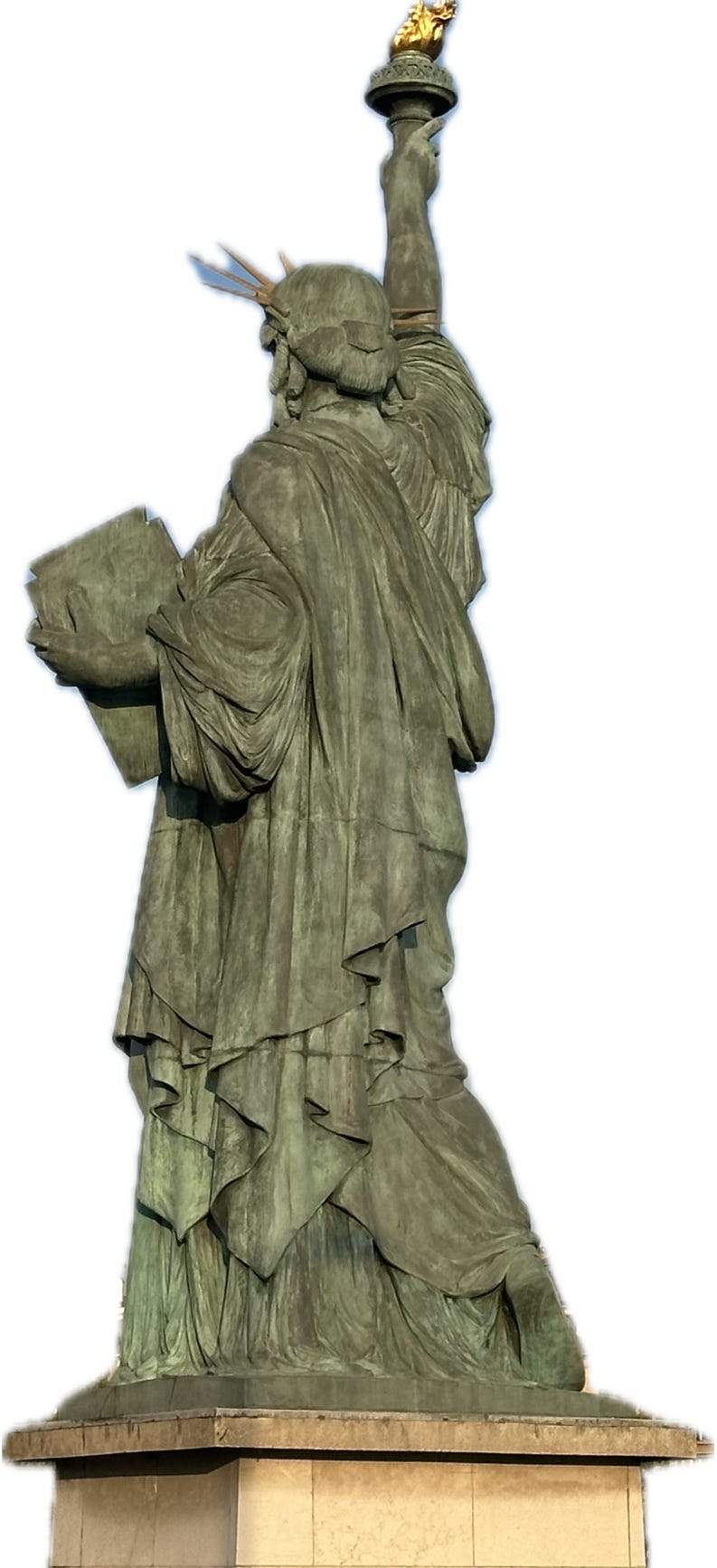
Auguste Bartholdi gifted the United States the Statue of Liberty on the centennial of the French Revolution, in part to urge his nation to learn from its counterpart in liberty. In a similar manner, I wish to pay homage to France on the 250th anniversary of American Independence, to urge us to remember our roots and to return to collective mental health.
Announcement:
Dr. Bandy X. Lee will hold her next planning meeting for Survival University on Monday, July 27, 2026, at 6 p.m. EDT / 3 p.m. PDT. Paid subscribers will receive a link an hour before meeting times.
Discussion about this post
https://bandyxlee.substack.com/p/the-end-of-the-age-of-reason

Powerful and important history lesson. Should be compulsory reading for all Americans who, unaware of their own history, have lost touch with reality.
Bandy, this is a provocative historical-psychological comparative analysis that enlarges the context of your psychiatric-political observations, admonitions and warnings.