Are we thinking about the Israel-Hamas conflict all wrong?
Are we thinking about the Israel-Hamas conflict all wrong?
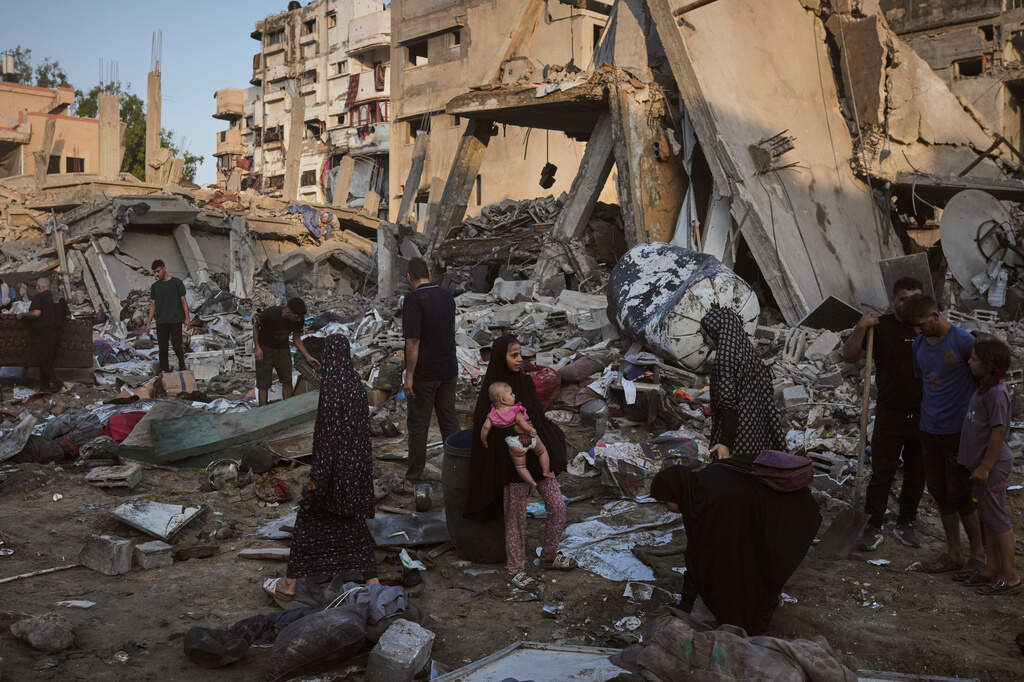
Ahmed Fouad Alkhatib is a pro-Palestinian, anti-Hamas expert who grew up in Gaza City. He says a realistic path to peace in the Middle East requires different thinking.
Guest
Ahmed Fouad Alkhatib, resident senior fellow at the Atlantic Council. Co-founder and director of Realign for Palestine, an Atlantic Council project that aims to challenge entrenched narratives in the Israel and Palestine discourse. Author of the book "Hamas and Its Two Million Hostages.” He grew up in Gaza City.
Transcript of Full Broadcast
The version of our broadcast available at the top of this page and via podcast apps is a condensed version of the full show. You can listen to the full, unedited broadcast here:
Part I
MEGHNA CHAKRABARTI: Ahmed Fouad Alkhatib is a resident senior fellow at the Atlantic Council, a Washington, D.C. thinktank. He is Palestinian and grew up in Gaza City. Though he lives in Washington now, as a boy, Ahmed was almost killed by an Israeli airstrike when he was in Gaza City.
Support WBUR
In the current war that's been going on since Hamas' October 7th attack against Israel, more than 30 of his relatives still in Gaza have been killed by the Israeli military. Now, these experiences have shaped his view of the Israeli-Palestinian conflict, though perhaps not in the way you'd expect. Ahmed has a new book and memoir.
It's called Hamas and Its Two Million Hostages, where he says that not only has two decades of Hamas' rule in Gaza stifled hope and possibility for his people because of what he calls Hamas' quote, "cold calculation that victory against Israel depends on sacrificing the lives and livelihoods of more than two million Gazans."
He also says that any way forward for the Palestinian people requires recognizing Israel, and he joins us now. Ahmed Fouad Alkhatib, welcome to On Point.
AHMED FOUAD ALKHATIB: Great to be with you. Thank you.
CHAKRABARTI: So I'd actually just like to start with your boyhood if we could, to get to know more about your experiences.
What was life like when you were growing up in Gaza City?
ALKHATIB: One of the things that I like to always share about Gaza is that it's a very complicated, complex place with immense beauty and immense meaning for its people, the beaches, the food, the family connections. Even with all the hardships that we experience, even with all the challenges, so many amazing formative memories were formed in Gaza.
Even with all the hardships that we experience, even with all the challenges, so many amazing formative memories were formed in Gaza.
I got to experience the tail end of the Oslo process with the hope and optimism that entailed, of flying into the newly established Gaza International Airport onboard the newly created Palestinian Airlines. I got to see my family obtain our first cellphone, our first landline that were provided through a Palestinian telecommunications company.
Support WBUR
I got to experience the renaissance, if you will, that Gaza was experiencing with the industrial zone in northern Gaza. The hope, the feeling that we really were marching towards statehood with all the state institutions that were being created. And then I also got to experience the fear and the terror and the trauma associated with the Second Intifada and the violence, both as far as the Israeli bombardment and the escalation of confrontations with the Israeli side, but also how that translated internally in terms of the Palestinian society, in terms of the rise of Hamas, in terms of what that meant for the collapse of the peace process. And so Gaza is a beautiful place that meant so much to me, so much to my family, even though we experienced so much suffering and hardships there.
CHAKRABARTI: Okay, so there's a lot that you said I want to come back to, but I did mention at the beginning here that when you were 11, you experienced an Israeli airstrike.
Can you tell us about that?
ALKHATIB: Yeah, so I was walking home. I went to UNRWA schools. UNRWA is, of course, the not so controversial UN refugee agency that everybody talks about right now. But I grew up in the UNRWA system, and we were walking home from school to my household. We walked approximately three kilometers every day to and from school each way.
And I started walking faster than a group of three friends of mine. And about two minutes, this was in November of 2001 when I was 11 years old, two minutes after walking faster and wishing to just get home sooner, there was an Israeli airstrike, a very massive one using a fighter jet, perhaps an F-16 or an F-15, that struck a Palestinian security forces building.
I panicked. I knew that they had just, I turned around, and I knew that they had been right by the site when it was hit. And instead of running away from the blast area, I actually ran towards it. And I was trying to look for them. Of course, there were a lot of other people rushing to the site.
And unfortunately, while I was in there looking, trying to locate them there was a follow-on airstrike that commenced. And I was right next to the building when it was hit, and the concussive wave of the blast caused me permanent hearing damage in my left ear that's still with me to this day, and I lost two of my friends in that airstrike. ... So that was the ... kind of, it planted the seed for me that I really had to get out of Gaza. I felt so threatened by the trajectory of events. And I also began learning English, and I became one of the top speakers actually of English in the Gaza Strip, and I knew that English was going to help me escape Gaza and seek a better life even temporarily outside of the coastal enclave.
I knew that English was going to help me escape Gaza and seek a better life.
CHAKRABARTI: So you decided, as you said, you had to get out of Gaza, and you were, you managed to leave, what, four years later in 2005?
Support WBUR
ALKHATIB: Precisely. I was 15 years old and came to the U.S. as an exchange student. It was a post 9/11 initiative to build cultural bridges and bring young Muslim and Middle Eastern students to the United States for high school exchange, live with a host family, and then supposedly return to your native homeland and build cultural bridges.
Upon doing so, I attempted to return in the summer of 2006 in June, but that was when Hamas went ahead and carried out a very miniaturized October 7th attack in which it conducted a cross-border attack into Israel, abducted Gilad Shalit, a young Israeli soldier, and brought him back into Gaza.
That started a mini war that actually got the borders closed for many months. And I was stuck in Egypt. I couldn't get back to my homeland.
CHAKRABARTI: So you tried to, but couldn't get back. Okay. Now, I understand, just going back for one second, Ahmed, there's a story about something that your father told you when you left in 2005?
ALKHATIB: Well, this is I'm wondering if you're referring to my uncle. He was one of the last people that I saw. I mentioned him in my book.
CHAKRABARTI: Uncle. Sorry. My mistake.
ALKHATIB: No problem. I left Gaza one month before the withdrawal of Israeli settlements, or what was known as The Disengagement, and this was the pulling out by then Israeli Prime Minister Ariel Sharon of all the Jewish-only settlements out of the Gaza Strip.
Many believe in pursuit of peace. Others argue it might have been part of a double-sided plan to forestall the establishment of a Palestinian state. Regardless, it was a time of immense optimism, immense hope, immense possibilities that Gaza could become a role model, if you will, for what happens when the Palestinian people obtain their freedom, and their ability to self-govern.
And I saw my Uncle Riyad, who was a day laborer in Israel. Day laborers were very big in the '80s and especially in the 1990s, so much so that the joke in the 1990s was that Gazans occupied Israel because so many Gazans were working in Israel, not just as construction workers. They worked in property management.
Support WBUR
They worked in agriculture. They worked in textile factories. They worked in restaurant services. And these weren't just day jobs, make money and get out. Over time, they became a window through which Palestinians and Israelis could glean, gain an understanding, if you will, of each other, and they developed lasting bonds and lasting relationships.
When the Second Intifada of 2000 began, most of those day laborers lost the ability to work, and a large number of them developed severe psychological, not to mention financial issues because they just ended up being stuck at home, and that was my Uncle Riyad. So he was one of the last people.
He was my dad's youngest brothers. He's the last person I saw in Gaza, and he said, "Inshallah, when you come back a year later, the withdrawal would have happened, and things will be much better, and I'll go back to working in Israel." Sadly, not only will I not go back to Gaza a year later, not only will the withdrawal not proceed as anticipated, but in 2023 my Uncle Riyad was killed in an Israeli airstrike that destroyed our family neighborhood and rendered him to mushy tissues and human remains that were under the rubble for approximately two weeks before we pulled out any of his remains.
CHAKRABARTI: Huh. I'm sorry I mentioned your father because I thought in an op-ed that you wrote, you had attributed that story to your father. It was from, but am I mistaken about that?
ALKHATIB: I mentioned other stories about my father, my dad, he had a great influence on me as far as maintaining political independence.
And I grew up in a politically independent family. And I mention that in the book. I've mentioned that in multiple op-eds. A lot of people have curiosity about what was potentially different about my upbringing that didn't allow me to either be a part of the Hamas narrative or fall for some of the ... nationalism of the PA or Fatah or the PLO.
And I've often attributed that to my father, in my upbringing in Gaza. Of course, over the past two decades, my father passed away six years ago in Gaza. He was a director for UNRWA's Jabalia clinic. He was a doctor for UNRWA for many years, and he ran their Jabalia clinic, which is one of the largest refugee camps in Gaza, just north of Gaza City in the north.
Most of Jabalia has now been destroyed. But he very much so had a significant impact in terms of how he grounded me, my understanding of Gaza. But also, I should say, he was part of, he was a very pious religious man. And he was part of our mosque community, the very mosque that I wrote about extensively in this book.
And actually, when he passed, right before he passed away, he told my mother ... two things. Number one, that Hamas had tried multiple times to recruit him and that he did not want to do that. And he tried very politely; you have to be polite with these people to say no.
Support WBUR
He was like, "I'll consult for you if you insist, but no, I really don't want to be a part of your apparatus." And number two is he confided in my mom that he, with his own eyes, because he, and for really pious Muslims, you have to pray the late evening and the early morning prayers in the mosque to really prove your piety.
And they took note of that. But he, with his own eyes confided in my mom that he saw weapons stored at our mosque.
Part II
CHAKRABARTI: So you were telling us how your father had told your mother that in the very mosque where he prayed in Gaza, this is even after Hamas had tried to recruit him, that he saw that the Hamas was storing weapons in the mosque?
ALKHATIB: Precisely that. And in fact, this is only something that my mom shared with me two years ago long after he passed away, and only after October 7th. He shared with her his pleasant surprise that thus far the mosque had not been targeted by the Israeli military. And he was very concerned that this was a violation of the sanctity of the place because it's not supposed to be, he's a very committed Muslim man, he was. But he didn't really think that it was appropriate to mix Hamas' activities that they call resistance, which unfortunately for Hamas meant free license to abuse and use all forms of infrastructure. He felt that was really inappropriate, but he didn't really have anyone else to share that with except for my mother.
CHAKRABARTI: Ahmed, you're going to have to forgive me because there's so much I want to cover with you that I might push us along. But if there's a moment you want to stick with and go deeper, by all means, do. I oftentimes feel frustrated with the minimal amounts of time we have in these conversations.
But so given the story of your life as you've just told us, growing up in Gaza City, being trapped in Israeli airstrike when you were 11, leaving when you were, what, 15, 16, and being unable to come back. Subsequently, not only your father, but your uncle, 30 members of your family having been killed in the Israel war in Gaza since October 7th.
These are the stereotypical pieces that when people put them together, they think Ahmed would be very supportive of, quote, unquote, "resistance" of Hamas' attempts to resist Israeli occupation. And yet how would you describe, simply put your view of what Hamas is?
When I came back to the United States thanks to the support of human rights and peace activists and really saved my life and enabled me to be here, I started applying for political asylum. There was a risk because I spoke English. Hamas had approached me when I was a boy in Gaza, and also the program I participated in was a novelty, and it was under a lot of suspicion by Hamas and others.
Support WBUR
The very day that Hamas took over the Gaza Strip violently was June 14th, 2007, which is the very day that I had my asylum interview in the United States. I was 17 at the time, and I was actually the first Palestinian from Gaza to receive asylum in the United States, political asylum that is, in the United States because of Hamas' control.
I was actually the first Palestinian from Gaza to receive [political] asylum in the United States ... because of Hamas' control.
That's a very grim milestone. But to me, that basically tells you everything there is to know about how Hamas' rise to power, Hamas' ascent to the control of the Gaza Strip. Both in terms of the last 20 years, but also their rise in starting in the late '80s, has really been nothing short of a catastrophe, a modern-day catastrophe for the Palestinian people.
It had radicalized the society, moved the Overton window, reduced democratic aspirations. It had undermined a fragile yet viable Oslo peace process. It had done everything it could to turn Gaza not into the crown jewel of the Palestinian peoples and the pride and joy of self-governance of Palestinian arts, culture, overlooking the Mediterranean, an airport, and a seaport.
And a compelling example of what an occupation-free West Bank would look like. But Hamas very much so was a gift to the far right in Israel. It was a gift to anti-Palestinian forces in Israeli society. And so that was, that is not hard to register and construct, especially when you see it up close.
Hamas very much so was a gift to the far right in Israel.
CHAKRABARTI: But of course, as one of the most impassioned counterarguments to what you just said, which we hear all the time, for example, just last year, the Palestinian envoy to India, Abdullah Abu Shaweesh, was quoted as saying that, quote, We will not accept anyone to designate Hamas or label Hamas as a terrorist organization because we, the Palestinian Fatah movement, exercise the right, and this is our right according to international law, to resist basically the military occupation of Israel.
Long story short, the counterargument is that were it not for decades of the brutality of Israeli occupation in Gaza, that Hamas would have had no emotional or political foothold to begin this rise. So it's not Hamas that's the problem, it's Israel.
ALKHATIB: And if I had a penny for every time I hear that. And the good news is that so many Palestinians in Gaza and elsewhere, but especially in Gaza, think and believe and will tell you exactly what I'm about to say.
Support WBUR
But just real quickly, I have to emphasize something of the utmost important importance, and this is why I do what I do. This is why I speak up despite immense personal cost and risk. This is why I wrote this short book. This is why I'm even relevant, is that there's a total disconnect in the discourse, the pro-Palestine discourse, the Palestinian national identity, and how it's manifested abroad, how it's communicated to the outside world between the diaspora, between whether it means in the West Bank, whether it means in the Arab and Muslim world, whether it means the Palestinian Americans or Palestinians in Europe or elsewhere versus the people of Gaza, the Palestinian people in Gaza, those who have to deal with the consequences of Hamas.
So it is very easy to be pro Hamas when you don't have to deal with the consequences. It's very easy to pontificate these lofty ideas about resistance and to also recycle these tired old points about why Hamas is relevant, et cetera. It's very simple. Hamas is an inorganic component of the Palestinian society.
It rose on the backs of a wave of Islamism in the Arab and Muslim world, especially in Egypt and in Saudi Arabia, beginning in the late '70s and early '80s. This metastasized into an organization that infiltrated the society, a society in need, a society, yes, under direct military occupation.
But a society that was historically very secular, that was historically not leaning towards Islamism and 'from the river to the sea' to establish an Islamic state for all. Hamas used social welfare, they used social services, then they used the mosques, then they used the educational services, the kindergartens, the private schools to entrench themselves and build a network that by the time they launched officially in '87, then they leveraged this infrastructure for the armed resistance narrative.
Now, what is the armed resistance narrative? And this is unfortunately where it took the Palestinian president almost a year or a year and a half or to condemn October 7th and to condemn Hamas. Even though I know I've spoken to President Abbas in the past. The Palestinian Authority, they despise Hamas.
They hate Hamas. They're enemies. They're mortal enemies of Hamas. But what Hamas has done is they've shifted the Overton window of what is acceptable discourse in the Palestinian society. And that's why you hear this ambassador and many others unwilling to condemn Hamas, unwilling to condemn terrorism, unwilling to condemn the taking of women and children as hostages, and unwilling to condemn the basic fact, which is that October 7th isn't about decades of Israeli occupation or Israeli militarism.
Hamas has ... shifted the Overton window of what is acceptable discourse in the Palestinian society.
October 7th is a narrow decision by two, forgive the expression, psychopaths, Sinwar and Deif, two leaders within Hamas who actually didn't even consult the rest of the organization. So it's very difficult to hear these justifications.
CHAKRABARTI: We're going to talk a little bit later, Ahmed, about how these kinds of things that you say make many people believe that you're just a flat-out Israel apologist.
Support WBUR
I'll get to that.
ALKHATIB: Or a Zionist.
CHAKRABARTI: Or a Zionist. I'll get to that. I'll get to that in a moment. But there are things that you write about in the book that I want to probe more. Because again, the title is Hamas and Its Two Million Hostages. ... I have some examples of how you make that case.
But also, I want to broaden it into how it's not just Hamas and its two million hostages, but Hamas and Israel, and their two million hostages. So first and foremost this is a little bit of tape you know it well. It's of Ismail Haniyeh, who was assassinated by Israel in July of 2024, former leader of Hamas.
He had been interviewed several years ago about a story regarding a possible $15 billion offer of aid that Hamas had received to develop the Gaza Strip, particularly an airport. And I believe you said you were actually either directly or indirectly involved with this. And he called the offer, it came from, quote-unquote, "superpowers."
So we'll hear a little bit of what Haniyeh said about this $15 billion offer to develop Gaza, and I will provide a translation
So Haniyeh says the idea was to build an airport and a seaport and to launch economic projects in the Gaza Strip. We told them, "That's excellent. We actually want that. We want a seaport and an airport. We want the blockade on the Gaza Strip lifted." That is a Palestinian demand. But then he goes on and he says, "But the question remained, what was the price?
What was the trade-off? Naturally, the price was something like disbanding the faction's military wings, the resistance, and integrating them into the police force, turning them into police officers. Of course, we categorically rejected that. We could not accept such a trade-off." Tell me about the significance of this, Ahmed.
ALKHATIB: This is Hamas in a nutshell. This tells you that, first of all, I wanna be clear about something. I am, I have zero interest in defending Israel. I am not Israel's lawyer. I have no doubts in my mind about the extent to which Hamas was a useful idiot for the far right in Israel. I know that Prime Minister Netanyahu benefited from Hamas' role.
Support WBUR
CHAKRABARTI: We'll get to this, Ahmed, we will absolutely get to this.
ALKHATIB: But I needed to qualify. I wanted to qualify because ... this is why the whole blockade narrative, to me, is kaput. This video, this audio to the listeners, this should render the whole narrative that Gaza was inherently the product of an Israeli design that refused to see it developed, that refused to see it become something prosperous, just because Israel is inherently against any form of Palestinian evolution or success or development.
That narrative is completely false. It is inaccurate. I have been in these rooms. Even as a young man, 10 years ago, I tried to build an internationally run Israeli approved airfield, and I had an army of engineers, and I'm not, this wasn't just an idea. This was a full detailed plan, and it began as a humanitarian airport.
It began and then it could evolve into being a Palestinian run airfield. Same thing with seaports, same thing with so many ideas that were floated. All Hamas had to do was to relinquish the idea of armed resistance in Gaza, because guess what? The Israelis no longer control Gaza directly. They pulled out their settlements.
Yes, Israel controls the airspace and the territorial waters. But naturally Israel is going to do that until there is negotiation on what does that look like. Is it temporary international management that transitions to Palestinian control? It's of course Israel wasn't going to pull out of Gaza and immediately hand everything over.
These things are gradual. They're gradual in Lebanon. They're gradual in multiple conflict zones around the world where the warring parties come to a gradual phased implementation agreement. So this clip by Ismail Haniyeh exposes the idea that Israel sealed, locked the key, that locked the Gaza Strip and threw away the key.
Israel had every interest for its own purposes in seeing Gaza evolve and develop, even though it had, some in Israel had their own designs for the West Bank. So why is Hamas bragging about the fact that they arrested Gaza's development for the sake of resistance? That guess what? Now they're disarming.
And I know we'll talk about that later. But now they're disarming. Now they're giving that up. What has the last 20 years achieved? We've had, do you know that Gaza has actually received over the last 20 years more per capita, more aid and development money per capita than any other conflict zone in the entire world?
And I actually think that's part of what entrenched Hamas' rule. And where has that gone? What has that achieved except for more wars more blockade, more loss of land, more tunnels, more rockets? And we've come full circle now, 20 years later, where Hamas is basically defeated. The armed resistance narrative has failed to achieve.
Support WBUR
What kind of freedom or liberty have we gained from Hamas' 20-year project? Whereas negotiations in the 1990s that Hamas called treacherous, that so many academics and journalists and activists in the Western world and in the U.S. and on college campuses say, "Oh, it's weak. It's treacherous. You're a sellout for engaging."
And that actually achieved, we got Palestinian passport, we got an airport, et cetera. So this tells you everything you need to know about why has Gaza been under a blockade. And this isn't in defense of Israel, but of any country that has a terrorist organization on its border that says, "I'm going to shoot rockets and build tunnels and smuggle weapons."
And then October 7th is the kind of like to prove it, right? Any country, Israel or Saudi Arabia or Egypt, are going to impose restrictions on this territory until that threat is eliminated.
CHAKRABARTI: And also, again, Haniyeh has been very public, had been, because he was assassinated, again, by Israel.
But he had been very public about his full knowledge of the cost of October 7th on the people of Gaza. For example, in a televised address in 2024, Ismail Haniyeh actually directly said that the blood of women, children, and the elderly were useful to Hamas. Here's what he said.
Haniyeh said, quote, "I have said this before and I will say it again, the blood of children, women, and the elderly, I am not saying this blood is calling for your help. We are the ones who need this blood, so it awakens within us the revolutionary spirit, so it awakens in us resolve, so it awakens within us the spirit of challenge and pushes us to move forward."
End quote.
Part III
CHAKRABARTI: Ahmed, we talked about your view of how Hamas not only, as you said, moved the Overton window, but really radicalized the Palestinian people. And also, we had that example of the fifteen billion dollar offer that Hamas got to develop a seaport and an airport in Gaza and rejected it, so how you see Hamas as having very actively prevented the positive development of Gaza.
Support WBUR
And again, I'm very taken by the title of your book, Hamas and Its Two Million Hostages, because you said that you don't think it's in Israel's self-interest at all to keep Hamas or to have Hamas right on its border, except there seems to be a lot of evidence that Prime Minister Benjamin Netanyahu does actually see it in his interest or his view of Israel's self-interest to even go so far as support Hamas.
And none of this will be news to you, Ahmed, but I do want to explain to listeners what I'm talking about. In 2024, there was a documentary released called The Bibi Files. It's by Alexis Bloom and Alex Gibney. They had received more than a thousand hours of leaked interrogation footage.
These are Israeli police interrogations of Prime Minister Benjamin Netanyahu in association with his corruption charges, the anti-corruption cases that are pending against the prime minister in Israel, so he was interrogated by Israeli police about this. And in this footage, there are recordings of Netanyahu talking about his secret ties to a, quote, "sworn enemy."
He says, "We may have not lit the fire, but we control the heights of the flames." So here's a little bit of that interrogation footage.
So Prime Minister Netanyahu's telling Israeli police, quote, "This is confidential and can't be leaked, okay? We have neighbors here, sworn enemies. I'm constantly passing them messages. I confuse them, mislead them, lie to them, and hit them over the heads." And what that's seemingly in reference to is the alleged Netanyahu coordinated funding of Hamas through Qatar.
So here's another clip from the Bibi Files in 2024 where experts describe how Benjamin Netanyahu was allegedly helping Hamas. At the same time that he was under investigation, he arranged for Hamas to receive $35 million every month from Qatar. Netanyahu can't give the money by himself. Israel will not give money to the Hamas.
You cannot even transfer this money through banks, because even the banks don't want to cooperate. So you, the Israeli prime minister, needs to beg this small and very rich country, Qatar, to give money to our enemy. And the Bibi Files documentary then has photographs of alleged literal suitcases full of cash that they say went from Qatar to Hamas at the behest of Prime Minister Netanyahu.
And in the documentary, they even show actual documents where the experts insist that the Qataris knew that Prime Minister Netanyahu would lie about this, so they allegedly had him put it in writing. Ahmed, talk about this, because I think this is a major part of the story, again, that gets obfuscated because there's so much focus on Hamas and its brutality, but that the sitting prime minister of Israel allegedly here has done everything he can to prop up Hamas through all of this.
ALKHATIB: And the problem is not just that this gets obfuscated. The problem here is that this alone should have actually been reason to de-legitimize Hamas from the get-go. Anybody who ever believed that Hamas is a real resistance organization, how can a real supposed resistance organization be propped up and supported by a right-leaning prime minister of Israel who has some of the most fascistic figures in his government?
Support WBUR
How can that alone not be cause for dismissing Hamas? But the short story here is that I strongly believe that after Hamas took over through the elections and physically took over the Gaza Strip, Netanyahu found it very convenient to indirectly guide Hamas towards the abyss of let's actually prevent Gaza from being developed.
Let's turn Gaza into a mini North Korea. Let's actually have Gaza be not the role model for successful Palestinian self-governance, but the role model for why we should never cede any more territories to the Palestinians. We should never evacuate any settlements from the West Bank. In fact, we should expand the Jewish-only settlements in the West Bank to make sure that we permanently kill the prospect of the two-state solution.
And in a way, Hamas was never about the two-state solution. So it had a tactical alliance with Netanyahu because Hamas, both Netanyahu and Hamas are two different sides in a sense of the river to the sea narrative, of Netanyahu wants Israel to reign supreme from the River Jordan to the Mediterranean Sea.
Same with Hamas. And so it was very much so a tactical alliance. He created a monster that he believed, or I should say he didn't create a monster. He emboldened a monster. Hamas precedes Netanyahu, but he emboldened and maneuvered around the monster.
CHAKRABARTI: And funded, apparently.
ALKHATIB: With billions of dollars in Qatari funds.
And by the way, the Qataris would never dare do this on their own. They're housing the biggest U.S. air base in the region. The Qataris are basically tools of U.S. foreign policy and their own aspirations in the region. So they too had a convergence of interest because that's their bread and butter, is talking to the groups like the Taliban, like Hamas, like even elements of Al-Qaeda to get to get hostages out.
So that is the issue with Prime Minister Netanyahu on October 7th, is that we've known for years that if you're going to pump Hamas full of billions of dollars, they're not. And they've already said no to an airport, and they've already said no to a seaport.
What were they going to do with this money? They were going to train, they were going to build tunnels, and attack eventually.
Support WBUR
CHAKRABARTI: So here is the grotesque truth. The grotesque truth is that on the one side there's Hamas, who obviously, as you've laid out, you believe no true interest in helping the actual people of Gaza, though they have been in power in Gaza for 20 years.
On the other side, you have Prime Minister Benjamin Netanyahu, who sees Hamas as a politically expedient tool. The quote of him saying to Israeli police that, "We didn't start the fire, but we can control the height of the flames," is truly damning. But in the middle you have the people of Gaza, two-plus million people who are essentially trapped in this meat grinder, to put it bluntly, of radicalism and political nihilism.
But these are the two groups that the U.S. is ostensibly trying to broker a peace plan with. Neither side has any actual interest in peace. The fact that Netanyahu rejected the latest proposal comes as a surprise to no one. I think maybe the greater surprise is that Hamas said yes, but the proposal doesn't actually even really require Hamas to do that much.
So where do you go? Where do you go if both sides in a negotiation, they actually have the same interest, which is no peace?
ALKHATIB: And I will gladly share that. Just real briefly, the most important thing, there's a narrative component to this that I think, a takeaway, a narrative takeaway.
Do I think that Israel bears responsibility for what has gone on in Gaza before October 7th and since? Absolutely. 100%, that's undeniable. However, just because someone set a trap for you doesn't mean you walk right into it. If you see a bear trap right in front of you, you don't walk right into it and say, "Oh my God, they set a trap for me."
Do I think that Israel bears responsibility for what has gone on in Gaza before October 7th and since? Absolutely. 100%. ... However, just because someone set a trap for you, doesn't mean you walk right into it.
Similarly, my thesis, my point, is that within the imbalance of power dynamics between Israel and the Palestinians, who are much more disadvantaged on every metric of power, there very much so still is space for Palestinian agency, responsibility, and accountability. And that is not blaming the Palestinians.
That is not blaming the victims. That is not a form of self-hatred, as some of my detractors say. To me, that's actually the first step in empowering the Palestinian people, recognizing that Palestinian people, specifically their leadership, specifically Hamas, made a decision, made a series of choices, to squander the 2005 withdrawal to militarize Gaza, to basically get in bed with Prime Minister Netanyahu and enable the far right in Israel, and finally, to launch the deadliest single-day attack on the Jewish people, and thereby triggering the worst catastrophic episode for the Palestinian people in contemporary history.
Support WBUR
So that promotion of agency is what's missing from the discourse. It's what's missing from the pro-Palestine activism groups. It's what missing from a lot of Palestinian American diaspora communities, from even Palestinians in the land, mainly in the West Bank. But it's also missing from the intellectual discussion.
As far as the deal itself, I actually think Hamas very much so recognizes that it has hit a dead end. It's looking regionally at a weakened Iran, at an isolated Hezbollah. It's looking at basically a Qatar that can no longer pump it full of billions of dollars. It's looking at catastrophe. The international community isn't pumping a penny in Gaza with Hamas in control.
And so they realize that the era of armed resistance as we've known it before October 7th is very much so over. So that's on one end. On the other end, we saw remarks from the Trump administration that they're not surprised by Netanyahu's rejections of the deal. They said verbatim, the quote, according to Israeli media, that the Trump officials are not bothered because they understand this is electioneering.
This is messaging. This is posturing. But Israel, too, is very much while it retains control of, almost 70% of Gaza, it has a full and complete domination over Gaza, it's also out of options. The elusive complete victory that Prime Minister Netanyahu promised for three years is not here, and it's not going to be here.
As much as I too would like to see Hamas decimated and destroyed, this is very much so the only viable path in which you have something in the middle of what we did in Iraq in 2003 as the United States de-Ba'athification, where we said zero remnants of the old regime whatsoever, and what the lasts, in the last three month, 10 months rather, since the ceasefire in October 2025, Jared Kushner and Steve Witkoff and elements of the Trump administration tried to bribe Hamas through other ways, in a different way, and it's been there, done that, guys.
Let's not do that.
CHAKRABARTI: So you see the only viable path meaning the current path that the Trump administration is on in trying to broker this peace? Is that what you're saying?
ALKHATIB: Very much as far as disarmament and partial reintegration of elements of Gaza's administration, Hamas, the government is separating Hamas the government from Hamas the terror entity, from the casual members of Hamas.
CHAKRABARTI: Okay. But if this is, in your view, the only viable path, then that path, neither party can take a step forward in that path concretely for as long as Prime Minister Netanyahu is still in office.
Support WBUR
ALKHATIB: That's conceivably the case. Although, we have to keep something in mind. Whether it's Prime Minister Netanyahu, whether it's Yair Lapid, whom I saw speak at the Atlantic Council a couple of weeks ago, came and spoke to us, whether it's Naftali Bennett, whether it's anybody, there is very much so only cosmetic differences between all the viable candidates, or Gadi Eisenkot.
Only cosmetic differences as far as the core security philosophy and apparatuses like systemic approach to Gaza between all the candidates. There is messaging and comms and public relations differences, and I think I would welcome a new Israeli government where you don't have ministers talking about just slaughtering the people or forcibly expelling them or starving them and getting them to leave under the guise of voluntary migration.
I think that's a helpful first step. But beyond that, all of them are going to insist on continued Israeli control that will only gradually recede after verifiable, there's nothing to trust about Hamas, as Nickolay Mladenov, whom I know personally, the head of the Board of Peace, verifiable measures that ensured Hamas' disarmament, the dismantling of the tunnels, and that areas gradually get taken over by a new Palestinian police apparatus and the international security force.
CHAKRABARTI: Okay. Unfortunately, we only have two minutes left, and there's one last thing that I do at least want to touch on with you. We mentioned at the top is the criticisms that you have received seemingly from all corners, but especially from supporters of Palestinians who are in the West.
Okay? Because I believe that there's some new article that was written about you that claims that you're being paid $30 million by Israel to promote genocide. That others call you one of those Palestinians who is so self-hating they support Israel. Even as you have actually, frequently, you've said you believe that Hamas are bloodthirsty terrorists.
You've also said openly that you believe that Prime Minister Netanyahu is a war criminal. And yet people have threatened your life. They've threatened your wife and children, although you don't have a wife and child. I just wonder what your message is to, especially in the United States, there's a whole cohort of folks here right now who are ascending in power, who look at Palestinian, quote-unquote, resistance in any way, shape, or form to Israel as something that should be supported without question.
We only have about a minute left, Ahmed.
ALKHATIB: Absolutely. So there's being pro-Palestine, and then there's being, like, actually pro-Palestine, and then there's being part of the pro-Palestine industrial complex. And that latter industrial complex has produced academics, has produced supposed journalists, has produced online personalities, social media activists, some politicians, folks who either leverage the Palestinian issue for self-gain.
They are ignorant. They don't want to hear inconvenient voices, Palestinians against Hamas, or Palestinians for peace, or Palestinians who are moderates, as much as I loathe the term moderates. But these are inconvenient voices. There's enforced conformity, enforced cohesion to prevent any disparate voices.
Support WBUR
The same people that embrace being fluid and open-minded, they have this binary approach to the Palestinian diaspora voice. I actually care about my people. It is precisely why I want to criticize Hamas, not in service of Israel, but in service of the people of Gaza and a much better future.
I actually care about my people. It is precisely why I want to criticize Hamas, not in service of Israel, but in service of the people of Gaza.
The first draft of this transcript was created by Descript, an AI transcription tool. An On Point producer then thoroughly reviewed, corrected, and reformatted the transcript before publication. The use of this AI tool creates the capacity to provide these transcripts.
This program aired on August 13, 2026.
https://www.wbur.org/onpoint/2026/08/13/are-we-thinking-about-the-israel-hamas-conflict-all-wrong


Comments
Post a Comment