Rolf Kvalvik -- JFK: Too Big To Fail Part 8
JFK: Too Big To Fail Part 8. THE CONCLUSION IS FREE FOR ANYONE TO SHARE
Sixteen articles. Four words. The anti-communist ultra-rich had already lost the biggest market in human history once. They were not going to lose again.
Series 2 Navigation
JFK: Too Big To Fail
PART 1 => PART 2 => PART 3 => Evidence Ledger => PART 4 => PART 5 => PART 6 => PART 7 => PART 8
Series 1 Navigation
WE KNOW WHO KILLED KENNEDY
Part 1 Part 2 Part 3 Part 4 Part 5 Part 6 Part 7 Part 8
⚡ Executive Summary: The Verdict in 90 Seconds
Four words.
That is what the CIA hid for fifty-eight years. Blacked out across four release cycles. Unredacted on March 18, 2025.
The Israeli Intelligence Service.
The sentence W.C. Sullivan wrote in the 1967 FBI memo reads that CIA directors permitted Angleton to run several intelligence projects, many of them with the Israeli Intelligence Service. The operational details were released decades ago. The country was the last thing to fall.
Sixteen articles across two series. This is what they add up to.
The class of 1949. The ultra-rich lost the biggest market in human history when China went communist. Rockefeller kerosene, Duke tobacco, the Sassoons on the Bund. Tens of billions in 1949 dollars. Zeroed out. The families who took the losses did not publish op-eds. They funded the political infrastructure to make sure it would never repeat.
By 1951 the operation was already running. Texas oilman Clint Murchison funded Joseph McCarthy’s Senate floor destruction of General George C. Marshall for the specific offense of having been Secretary of State when Mao consolidated Beijing. The message to every future American official was engraved into the record. If a country was lost on your watch, the class of 1949 would come for you.
Cuba in 1959 was the second China. Kennedy inherited it and gave every signal that he did not share the memory. Bay of Pigs betrayal. Missile Crisis capitulation. NSAM 263 signaling Vietnam withdrawal. Back channels to Havana. American University speech.
Three grievances converged on the same window. Miami wanted Cuba back. Dallas wanted the oil depletion allowance kept. Angleton wanted Dimona breathing. The class of 1949 wanted the Western Hemisphere held and the Israeli reactor unimpeded.
The financiers sat at the geometric center. Hunt. Murchison. McLendon. Walker as political vehicle. D.H. Byrd owned the Texas School Book Depository and was a founding investor in Ling-Temco-Vought, one of the largest Vietnam-era defense contractors.
The physics clock at Dimona set the date. Political windows can be reopened. Legislative windows can be renegotiated. A breeder reactor going critical cannot be reversed. That is why November 22, 1963, and not the next month.
The receipts are on the record. McGeorge Bundy drafted NSAM 273, reversing Kennedy’s Vietnam disengagement, on November 21, 1963. The day before Dallas. LBJ signed it on November 26. Four days after. Byrd’s LTV holdings appreciated dramatically on the specific war the reversal unlocked. The man who owned the building profited from the war. The war was unlocked by the reversal. The reversal draft existed the day before.
Receipts do not prove intent. Receipts prove alignment. The alignment was total.
The verdict is not a trial verdict. The record is too damaged. The verdict is a journalistic verdict. The sixteen-article arc identifies the class, the geometry, the physics, and the four words that together explain November 22, 1963 better than any competing account in the public record.
The four words are unredacted now. The name of the country is in the memo.
Next series: the doctrine merges with Sovereign Immunity as we walk the trustee layer above the operational tier. Two Warren Commission members ran the ratification. John J. McCloy and Allen Dulles. Top lieutenants of the Rockefeller gang, chairman of Chase and chairman of the Council on Foreign Relations, translating the class of 1949's consensus into the official cover story that has held for sixty-two years.
End of the quick executive summary.
Full piece below. Nine sections. Sixteen articles. One verdict.
THE CONCLUSION
Here is the Verdict
Four words.
That is what the CIA hid for fifty-eight years. Blacked out in 2017. Blacked out in 2018. Blacked out in 2022. Blacked out in 2023. Unredacted on March 18, 2025, for the first time in four consecutive release cycles across eight years of Freedom of Information denials.
The unredacted sentence reads: CIA directors permitted Angleton “to run several intelligence projects, many of them with the Israeli Intelligence Service.”
1. the
2. Israeli
3. Intelligence
4. Service
Four words. Hidden for 58 years. Released on a Tuesday morning in March while most of America was reading about something else.
The Israeli Intelligence Service.

The sentence W.C. Sullivan wrote in the 1967 FBI memo reads that CIA directors permitted Angleton to run several intelligence projects, many of them with the Israeli Intelligence Service. The operational details were released. The names of the officers were released. The name of the country was the last thing to fall.
CLICK TO VISIT USA GOVERNMENT ARCHIVE FILE
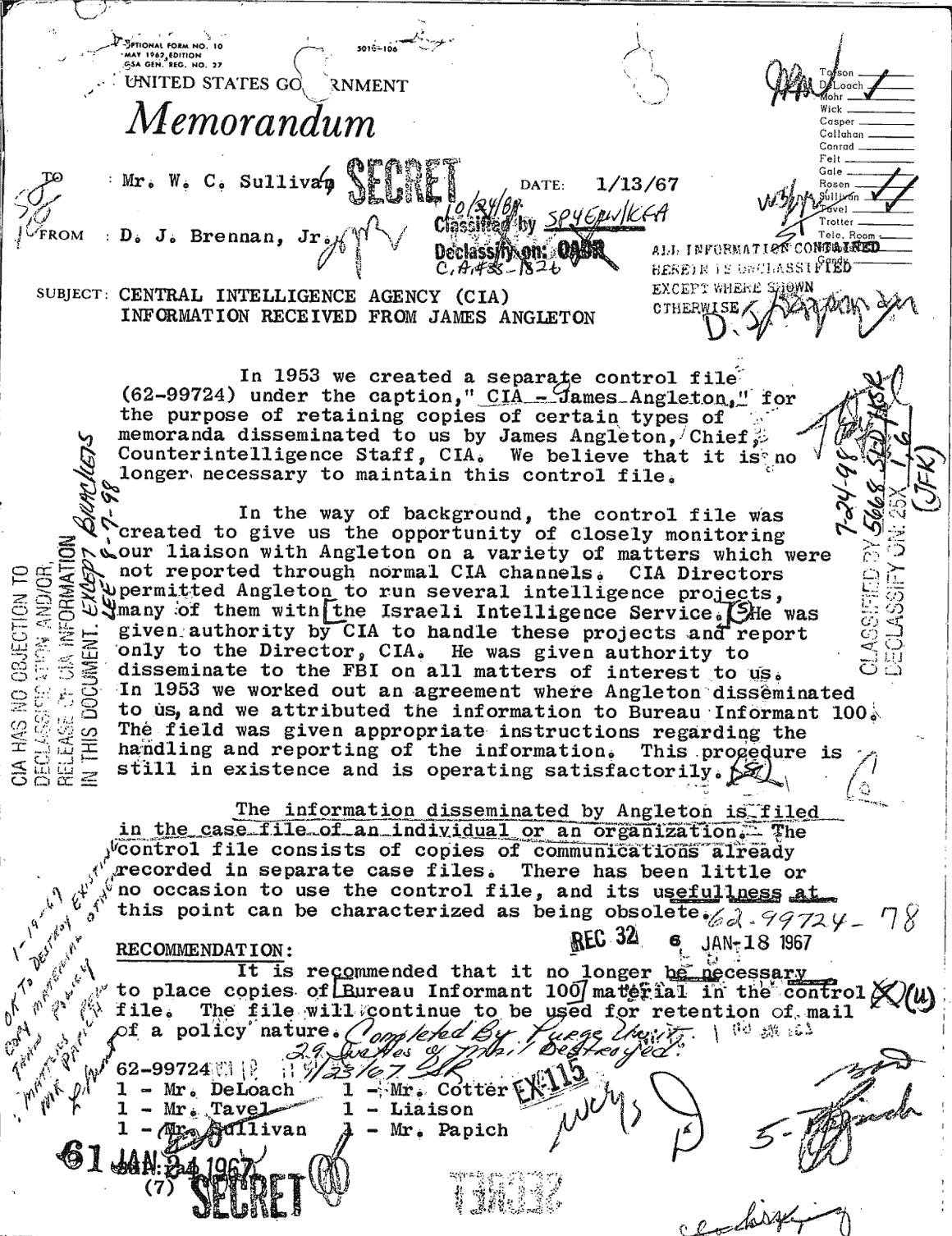
CLICK TO VISIT USA GOVERNMENT ARCHIVE FILE
Sixteen articles have walked around those four words. Series 1 opened with them. This is the article that says what they mean.
The verdict is not one grievance. It is the geometry of grievances converging on the same window. And the constituency that made the geometry viable was the same constituency that had already lost a country once. They had watched the biggest market on Earth walk out from under them in 1949, they had watched the Caribbean market walk out from under them in 1959, and by 1963 they were watching a young president in Washington DC give every signal that he was prepared to let it happen a third time.
This is what the ultra-rich learned from China. And this is why the physics clock in the Negev could not wait for the ballot.
🕯️ What China Cost
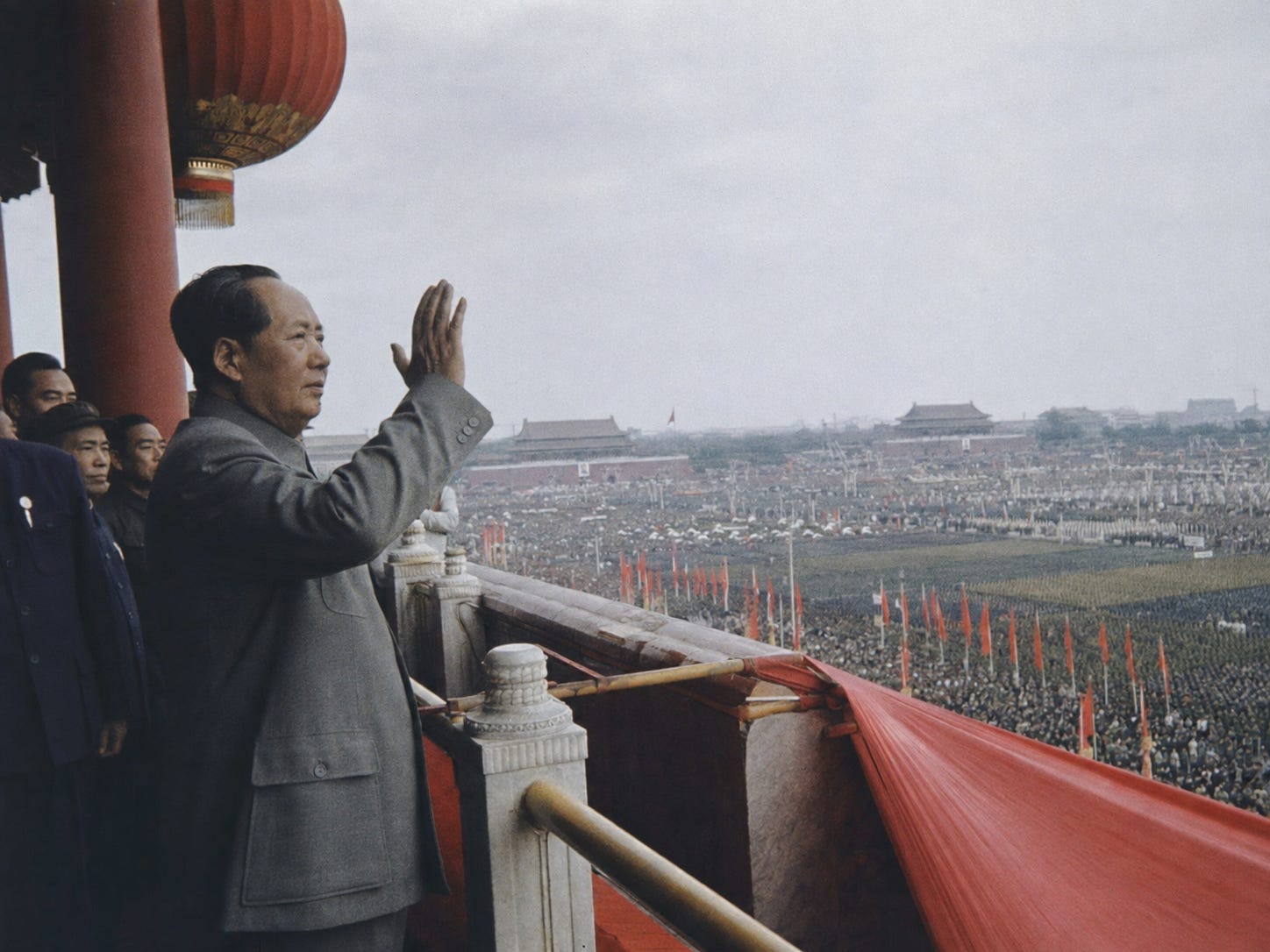
Mao at the Gate of Heavenly Peace
October 1, 1949. Mao Zedong stood at the Gate of Heavenly Peace and announced the founding of the People’s Republic of China. Chiang Kai-shek fled to Taiwan. Within eighteen months every foreign business asset on the Chinese mainland had been nationalized, expropriated, or driven out.
This was not a diplomatic setback. This was the single largest transfer of wealth in the twentieth century that did not require a world war. And the wealthiest families on Earth wrote off the loss in silence.
The scale is not remembered because the losers were not the kind of people who published memoirs about their losses.
Start with Standard Oil. The Rockefeller kerosene business in China had been built over sixty years. Standard Oil of New York, later Socony-Vacuum, later Mobil, had turned the Chinese peasant lamp into the most profitable oil market in Asia. The company distributed kerosene to villages where no other Western product had ever penetrated. Oil for the lamps of China was not a metaphor. It was a business line. And the Rockefeller Foundation had built the Peking Union Medical College, which by 1949 was the most sophisticated medical institution between Berlin and Tokyo. All of it nationalized. All of it gone.
Then British American Tobacco. James Buchanan Duke had merged American Tobacco with Imperial Tobacco in 1902 to create BAT, and BAT built one of the largest foreign enterprises in Chinese history. Cigarette factories in Shanghai, Hankou, Tianjin. Distribution networks that reached every village where Standard Oil sold kerosene. Chinese peasants smoked BAT cigarettes by candlelight fueled by Rockefeller oil for four decades. The two businesses moved together. They fell together. Duke money endowed Duke University. The endowment was not the point. The point was the market that had built the endowment was now closed forever.
Then the Sassoons. The Baghdadi Jewish family had migrated from Iraq to Bombay in the 1830s and from Bombay to Shanghai by the end of the nineteenth century, filling the void left when Parliament ended the East India Company's China monopoly in 1833. They were called the Rothschilds of the East for a reason. David Sassoon and Company had built its fortune on the opium trade into China, then textiles, then Shanghai real estate. Victor Sassoon had moved the family’s remaining Indian wealth to Shanghai in the interwar years and built the Cathay Hotel and Sassoon House on the Bund. By the 1930s the Sassoons controlled a Shanghai real estate portfolio that had no equal in Asia. By 1950 the entire portfolio had been seized. Victor Sassoon ended his life in the Bahamas.
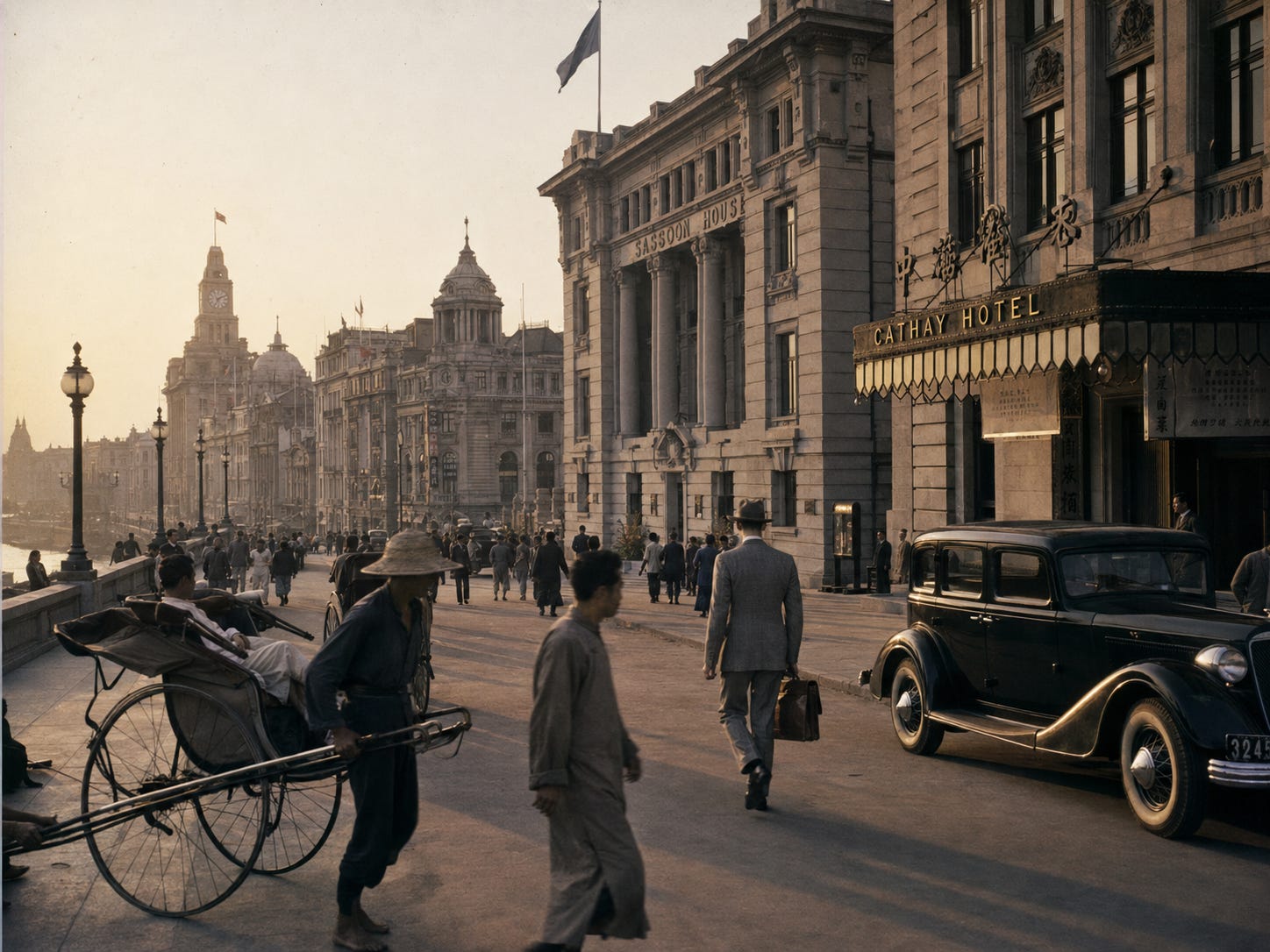
The Sassoon home in Shanghai
The Kadoories, another Baghdadi Jewish family that had partnered with the Sassoons across two generations of trade, escaped to Hong Kong with the fragments of what they could carry. The Hardoons were expropriated in full. The Ezras, the Abrahams, the Toeg family. A century of accumulated capital across four generations of Baghdadi Jewish commerce in Asia. Zeroed out.
And these were only the private families. The corporate losses ran into the tens of billions in 1949 dollars. Jardine Matheson. Butterfield and Swire. The British-American banking network. The Shanghai foreign concessions. The entire architecture of Western commercial penetration into China that had been built since the Opium Wars.
The political aftermath in the United States was the ten-year civil war inside American politics called Who Lost China. Joseph McCarthy rose on it. The China Lobby organized around it. The Committee of One Million ran a decade of pressure operations to keep Beijing out of the United Nations. The Republican right built a durable political identity around the premise that a Democratic administration had been penetrated by communist sympathizers who had allowed the greatest market on Earth to fall.
The families who had actually taken the losses did not publish op-eds. They funded the political infrastructure that made sure the loss would never repeat.
By 1951 the political operation was already running at full weight. Clint Murchison, the Texas oil billionaire whose La Jolla hotel would become the physical infrastructure of the anti-communist ultra-rich class across nineteen consecutive summers, was one of the principal financial backers of Senator Joseph McCarthy. McCarthy flew on Murchison’s plane. McCarthy vacationed at Murchison’s hotel. The hotel manager later described McCarthy as virtually on Murchison’s payroll.
On June 14, 1951, McCarthy delivered a sixty-thousand word speech on the Senate floor attacking General George Catlett Marshall. Marshall had been Army Chief of Staff during World War II, the architect of the recovery plan that bears his name, Secretary of State from 1947 to 1949, and Secretary of Defense during the Korean War. McCarthy accused Marshall of being part of a conspiracy so immense and an infamy so black as to dwarf any previous such venture in the history of man. The specific charge was that Marshall had permitted China to fall to communism on his watch.
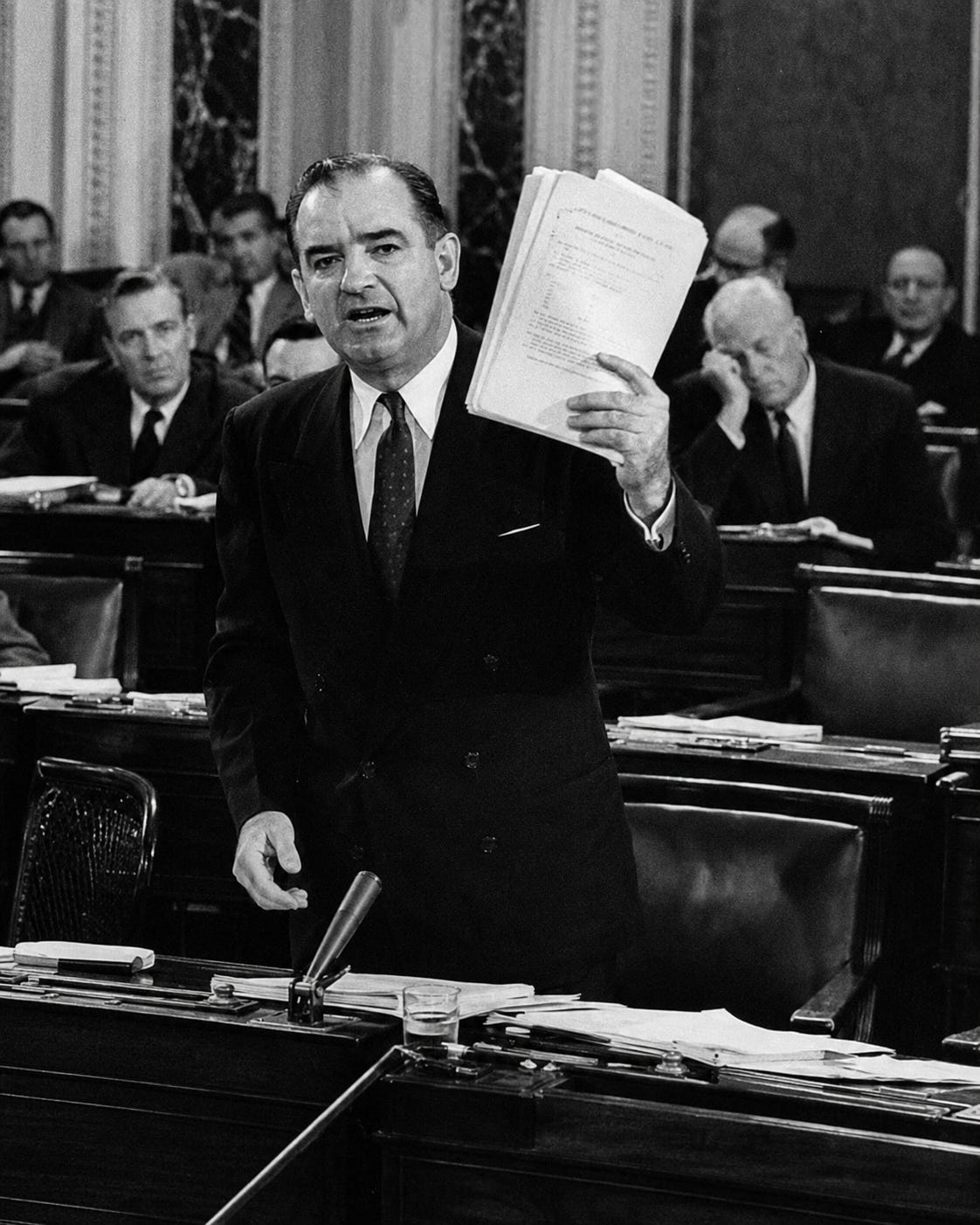
McCarthy Attacking Marshall on the Senate Floor, June 14, 1951
This is not incidental history. This is the class of 1949 taking one of the most decorated American military figures of the twentieth century and destroying his reputation on the Senate floor for the specific offense of having been Secretary of State when Mao consolidated Beijing. The funding came from Texas oil. The political vehicle was McCarthy. The message to every future American official was engraved into the record. If a country was lost on your watch, the class of 1949 would come for you.
Twelve years later, the same Texas oilman who had funded the operation against Marshall was hosting the FBI Director in Bungalow A of the Hotel Del Charro every summer of the Kennedy administration.
That was the class the Kennedy brothers walked into.
🌀 Cuba Was Not About Cuba
The people who had lost China in 1949 watched Cuba in 1959 and saw the pattern.
A peasant army marching out of the mountains. A charismatic revolutionary leader nobody in Washington had taken seriously. A wealthy elite fleeing to Miami with what they could carry in suitcases. Nationalizations that started with utilities and moved to sugar and moved to everything. American corporations losing holdings they had built over generations. United Fruit. American Sugar Refining Company. ITT. The Havana casinos that the Lansky organization had built with American mob capital. Standard Oil of New Jersey’s Cuban refinery. All expropriated within eighteen months.
The Cuba loss was a fraction of the China loss in dollar terms. In psychological terms it was a full repetition of the trauma.
And Cuba was ninety miles from Florida.
If Cuba could go, the Caribbean could go. If the Caribbean could go, Central America could go. If Central America could go, the whole southern flank of the American commercial empire was on a physics clock of its own. The domino theory that the State Department turned into Vietnam policy was, at its root, the corporate class of 1949 saying we know how this movie ends because we have already watched it once.
Kennedy inherited the Cuba problem in January 1961. Within four months he had presided over the Bay of Pigs. The exile brigade landed with insufficient air cover and was destroyed on the beach. The CIA officers who had planned the operation, and the exile political leadership that had trusted the operation, and the ultra-rich Cuban American community in Miami that had underwritten the operation, all reached the same conclusion in the same week.
Kennedy had betrayed them.
That was the operational grievance Series 2 Part 6 documented in Miami. But it was not only an operational grievance. It was the second China. It was the specific president who had chosen to let the specific communist regime consolidate on the specific island ninety miles from the American mainland. And every ultra-rich family that had lost holdings in 1949 was watching.
Then the Missile Crisis. Kennedy negotiated a settlement that removed Soviet missiles from Cuba in exchange for a public American pledge not to invade the island and a secret American commitment to remove Jupiter missiles from Turkey. The exile community in Miami read the pledge as ratification of Castro. The Joint Chiefs read the Turkey deal as capitulation. The ultra-rich anti-communist class that had lost China and lost Cuba read the whole episode as the American president trading the last serious lever against communist expansion in the Western Hemisphere for a face-saving press release.
And then the signals started stacking. NSAM 263 laying the groundwork for a phased withdrawal from Vietnam. Back-channel communications to Havana through William Attwood exploring a possible normalization with Cuba. Detente signals to Moscow. The American University speech in June 1963 calling for a rethinking of Cold War posture.
To the class of 1949, this was the pattern. A young Democratic president giving up ground the country could not afford to give up, exactly the way another young Democratic president had given up ground the country could not afford to give up fifteen years earlier.
They had watched the movie. They knew the ending.
They were not going to watch it a third time.
🎯 Three Grievances, One Window
Series 2 laid out three operational grievances against the specific president. Part 8 identifies the fourth constituency that made them converge.
Grievance one. Miami. The Cuban exile community, the CIA officers who had run the Bay of Pigs, the Morales JMWAVE machine that was operationally warm through 1963 and needed only redirection. Series 2 Part 6 documented this.
Grievance two. Dallas. The Texas independent oil producers who were losing a slow-motion war against the American majors, the political infrastructure that funded General Walker, the economic geometry of imported Middle East crude gutting the domestic wellhead margin. Kennedy had signaled he would end the oil depletion allowance. This was the political-economic front.
Grievance three. Angleton. The counterintelligence apparatus inside CIA that ran the Israel liaison and understood that the reactor at Dimona was a physics clock, and that Kennedy’s July 5, 1963 letter to Eshkol demanding inspections was the specific instrument that would strip American intelligence of its most valuable strategic partner if the pressure held. Series 2 Part 4 documented this.
Three grievances. Three constituencies. Three motivations.
They converge because they sit on top of a fourth constituency that connects them.
The ultra-rich anti-communist class was the connective substrate. The Rockefeller network had lost China and was watching Cuba with the memory of the Chinese loss still on the balance sheet. The Cuban exile community in Miami was the fresh version of what the Baghdadi Jewish families of Shanghai had been in 1949. The Texas independent producers benefited from every regional conflict that fractured the Middle East oil producers and kept imported crude expensive, which meant they benefited structurally from the Angleton doctrine that a strong Israel serves American strategic interests by fracturing the Arab bloc. And the Angleton compartment inside CIA was the operational expression of the same anti-communist ultra-rich worldview that had funded the China Lobby, the Committee of One Million, and every domestic political operation aimed at making sure no Democratic administration would ever be soft on communism again.
The class of 1949 was not a conspiracy. It was a shared political consciousness. It had a memory. It had a set of institutional expressions. It had money. And it had a young Democratic president in Washington DC who was giving every signal that he did not share the memory.
Miami wanted Cuba back. Dallas wanted the oil depletion allowance kept and the domestic producer margin protected. Angleton wanted Dimona left alone. The ultra-rich anti-communist class wanted the Western Hemisphere held and the reactor in the Negev breathing, because the two together were the only thing standing between the pattern of 1949 and the third repetition.
Three grievances. One window. One constituency underneath.
That is the geometry.
🚪 The Financiers at the Geometric Center
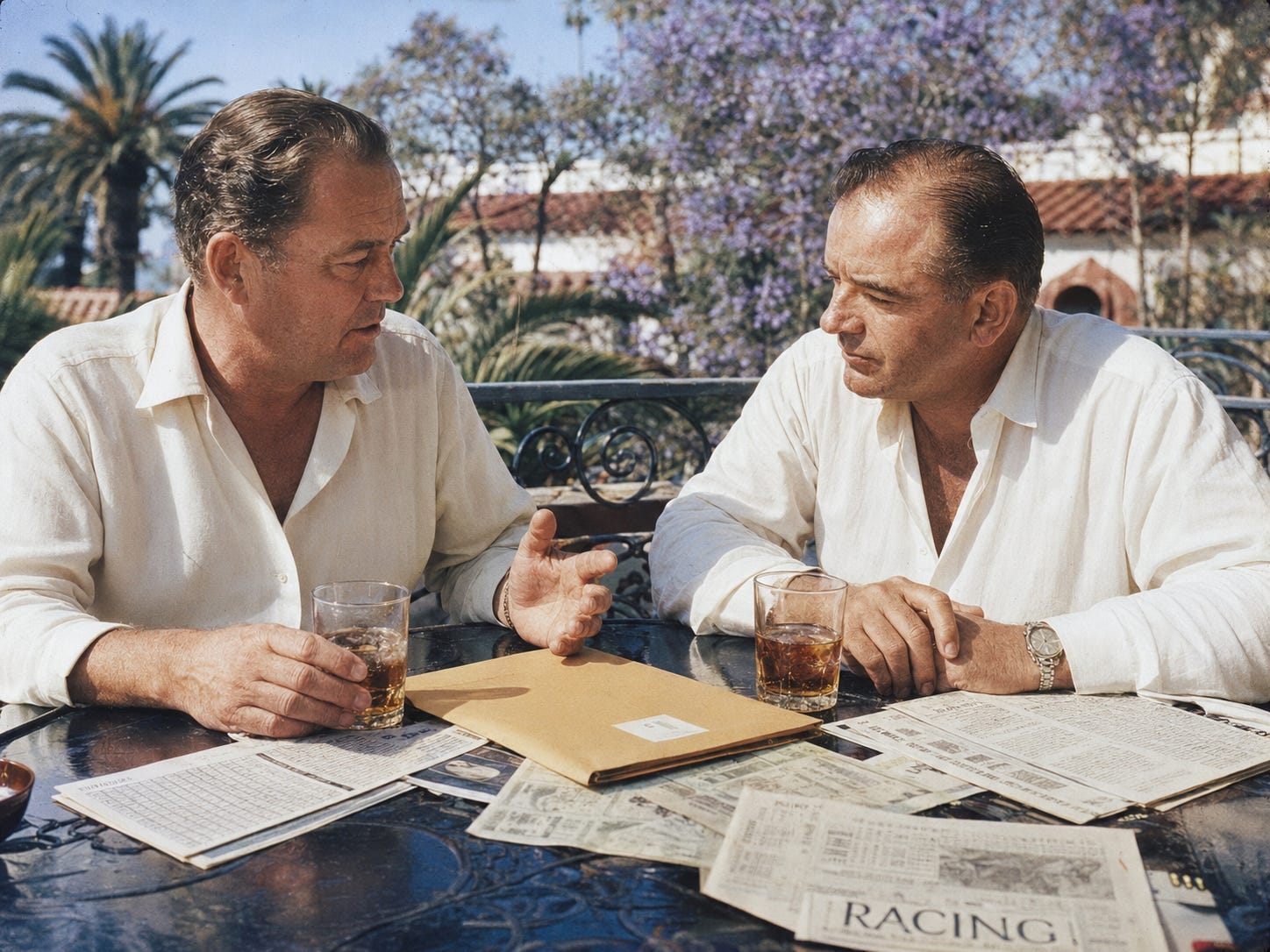
Clint Murchison Sr. and Senator Joseph McCarthy seated on the terrace of the Hotel Del Charro, summer 1953.
The financiers who sat at the intersection of all three grievances were the people who made the operational geometry viable.
H.L. Hunt. Texas independent oil, the wealthiest private American of his era at various points in the postwar period, and one of the most durable funders of the domestic anti-communist right. Hunt had every economic reason to want the oil depletion allowance kept. He had every political reason to want a fractured Middle East that kept imported crude expensive. He had every ideological reason to want a president who would not lose Cuba the way China had been lost.
Clint Murchison Sr. Texas oil, real estate, and the man who built the physical infrastructure of the anti-communist ultra-rich class in California. Murchison hosted J. Edgar Hoover and Clyde Tolson in Bungalow A of his Hotel Del Charro in La Jolla every summer for nineteen consecutive years from 1953 until Hoover’s death in 1972. Nobody at the hotel ever paid a bill. Journalist Jack Anderson broke the story in 1971 and totaled Hoover’s comped hospitality at roughly fifteen thousand dollars of 1971 hotel value, the price of a house at the time. The other guests at the same hotel across those nineteen summers, gathered in adjacent bungalows, included William King Harvey of the CIA’s ZR/RIFLE executive action program, Carlos Marcello of the New Orleans organized crime family whose territory included Dallas, Bobby Baker of the Lyndon Johnson political machine, Joseph McCarthy in the years Murchison was underwriting his Senate operation, Richard Nixon before and after his vice presidency, Roy Cohn, John Connally, and D.H. Byrd, the Texas oilman who owned the Texas School Book Depository. Series 1 Part 4 of this arc walked through the Del Charro guest list in detail. Its significance for Part 8 is that the class of 1949 was not an abstraction. It had a specific hotel, a specific bungalow numbering scheme, a specific set of summers, and a specific documented pattern of nineteen consecutive years during which the FBI Director, the CIA’s assassination chief, and the New Orleans mob boss whose territory included Dallas were gathering on Clint Murchison’s dime. This was the same Clint Murchison who had funded the McCarthy attack on General Marshall in 1951. The physical infrastructure of the class of 1949 was Murchison’s hotel. The political operation of the class of 1949 was Murchison’s money moving through McCarthy’s mouth. The connective institution between Texas oil, the FBI, the CIA’s assassination compartment, and the New Orleans mob was Murchison himself.
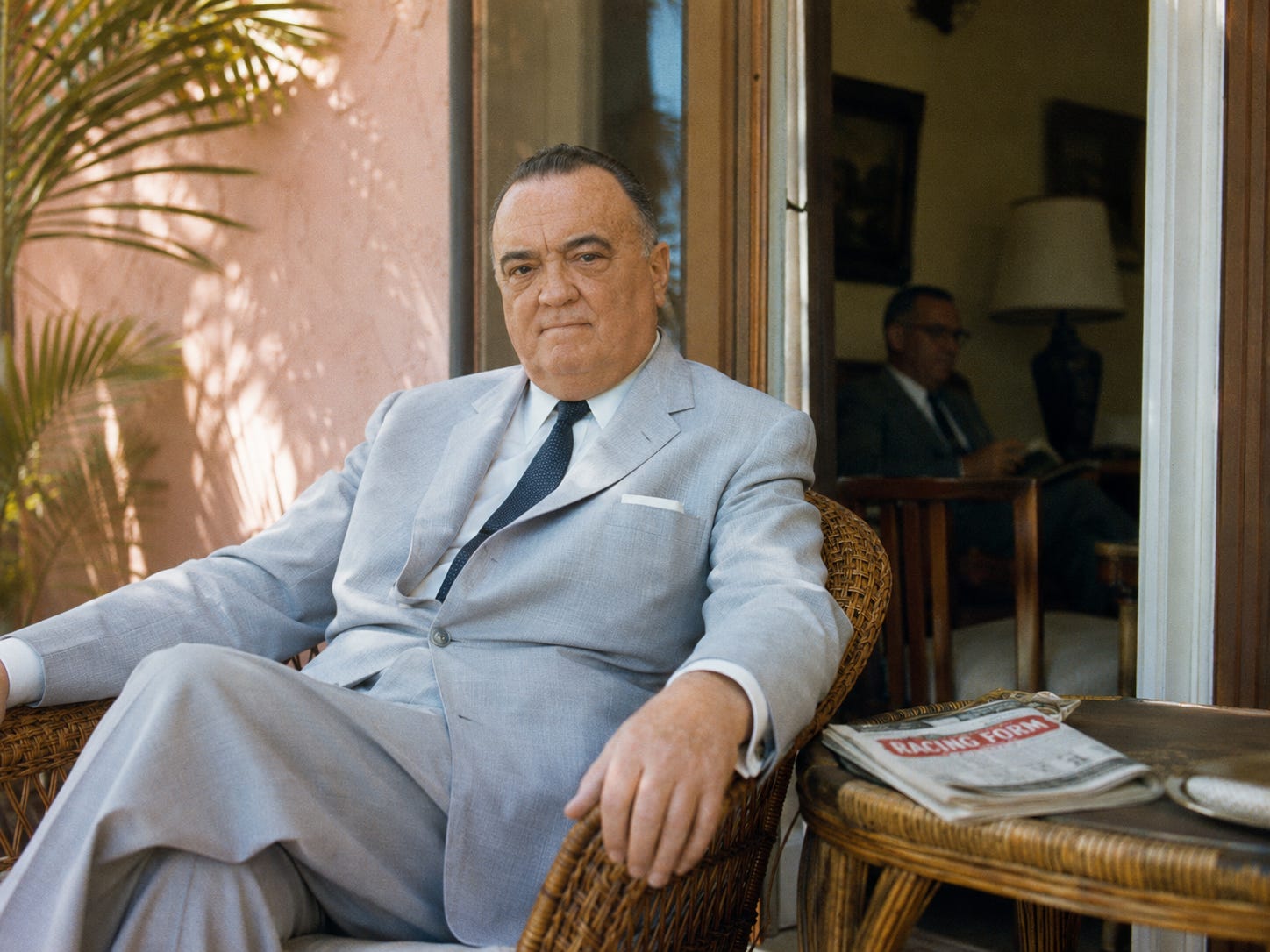
J. Edgar Hoover at the Del Charro, 1960s
D.H. Byrd. Texas oilman, Del Charro regular, and founding investor in Ling-Temco-Vought. Byrd purchased the building that would become the Texas School Book Depository in 1937 and owned it on November 22, 1963. He personally removed the sixth-floor window sash after the assassination and kept it as a memento in his private home. He was also one of the founding investors in Ling-Temco-Vought, the Dallas-based defense conglomerate that became one of the largest Vietnam-era military contractors, producing the A-7 Corsair II attack aircraft used extensively in the air campaign against North Vietnam. Byrd’s LTV holdings appreciated dramatically as the Vietnam escalation unfolded. The specific man who owned the building the Warren Commission concluded Kennedy was shot from was simultaneously a founding investor in the defense contractor whose value climbed on the specific war whose escalation was unlocked by the specific policy reversal that Kennedy’s death made possible. Byrd was also a Del Charro regular, which places him inside the same Murchison hospitality network as Hoover, Harvey, and Marcello. He also sat on the founding board of the Civil Air Patrol, the youth organization Lee Harvey Oswald had briefly joined as a teenager in New Orleans under the supervision of David Ferrie, a detail whose weight the Warren Commission chose not to develop.
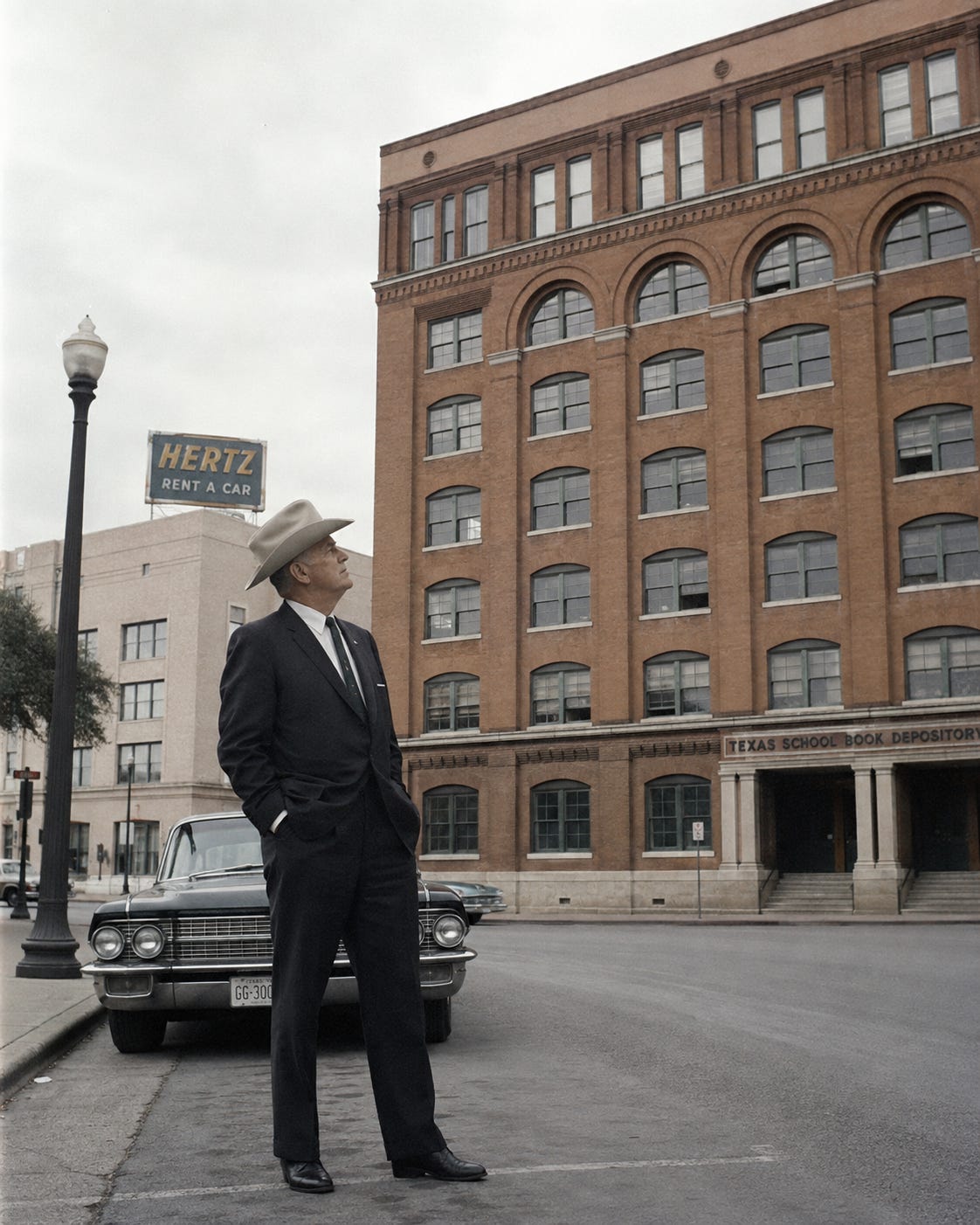
D.H. Byrd at the Texas School Book Depository
Gordon McLendon. Dallas broadcasting, the Liberty Network, and the specific communications infrastructure that connected Dallas media to the CIA propaganda networks that David Atlee Phillips ran. McLendon was the propaganda front of the same class.
General Edwin Walker. The political vehicle. Cashiered from the Army for distributing John Birch Society literature to his troops. Ran for Texas governor in 1962. Lost. Rebuilt as the public face of the ultra-right in Dallas. The specific individual Lee Harvey Oswald was alleged to have shot at in April 1963, seven months before Kennedy was killed in the same city.
David Atlee Phillips. CIA Western Hemisphere chief of operations. The specific officer whose Mexico City station ran the Oswald surveillance that November. Phillips is the operational link between the CIA compartment that Angleton protected and the Dallas media infrastructure that McLendon built.
Maurice Bishop. The name a Cuban exile leader named Antonio Veciana said he saw Phillips using in operational meetings. Bishop is the pseudonym that connects Phillips directly to the Cuban exile operational world.
Silvia Duran. The Mexico City employee at the Cuban consulate who is documented as one of the last people to see the man calling himself Lee Harvey Oswald in Mexico City in late September 1963.
Silvia Odio. The Cuban exile in Dallas who told the Warren Commission that three men, one of whom was introduced to her as Leon Oswald, showed up at her apartment in September 1963. The other two Cubans in the room used the operational names Angel and Leopoldo.
Bishop and Veciana in a Dallas coffee shop
The financiers sat at the geometric center of the three-way intersection because they were the only class with the money, the political cover, and the ideological consciousness to underwrite an operation that required Miami operational assets, Dallas political infrastructure, and Angleton compartmentalization inside CIA to converge on the same window.
The convergence did not require a meeting. It required the shared consciousness of a class that had already lost a country once and was determined not to lose again.
🔍 The Dallas Weekend
Antonio Veciana testified to the House Select Committee on Assassinations that Maurice Bishop introduced him to a man named Lee Harvey Oswald in Dallas in late August or early September 1963.
Veciana’s testimony was corroborated in part by the investigator who took it, Gaeton Fonzi, who spent the rest of his life working the case and eventually named David Atlee Phillips as Maurice Bishop in his 1993 book The Last Investigation.
Silvia Odio’s testimony was corroborated by her sister, who was in the apartment when the three men appeared, and by the Warren Commission investigators who were unable to explain her account within their lone-gunman framework.
The Dallas weekend before the assassination was the moment when the Miami operational side of the geometry made physical contact with the Dallas financier side. This is the physical handshake that ties the operational grievance from Miami to the financial infrastructure in Dallas. The specific mechanics of who met whom and where remain contested, but the operational shape is documented in the Fonzi record, the Odio record, and the Veciana record.
The three-way geometry stopped being an idea and became a place, a weekend, and a set of physical meetings.
Kennedy landed at Love Field five days later.
🕰️ The Physics Clock
Series 2 Part 4 established that the specific date of November 22, 1963 was determined by physics.
The Dimona reactor was breathing in. Once the fuel rods went hot and the plutonium began to breed inside the cladding, the window physically closed. Kennedy’s letter to Eshkol on July 5, 1963 was the specific instrument that would have forced the inspection regime that would have interdicted the plutonium extraction. The letter was on the table.
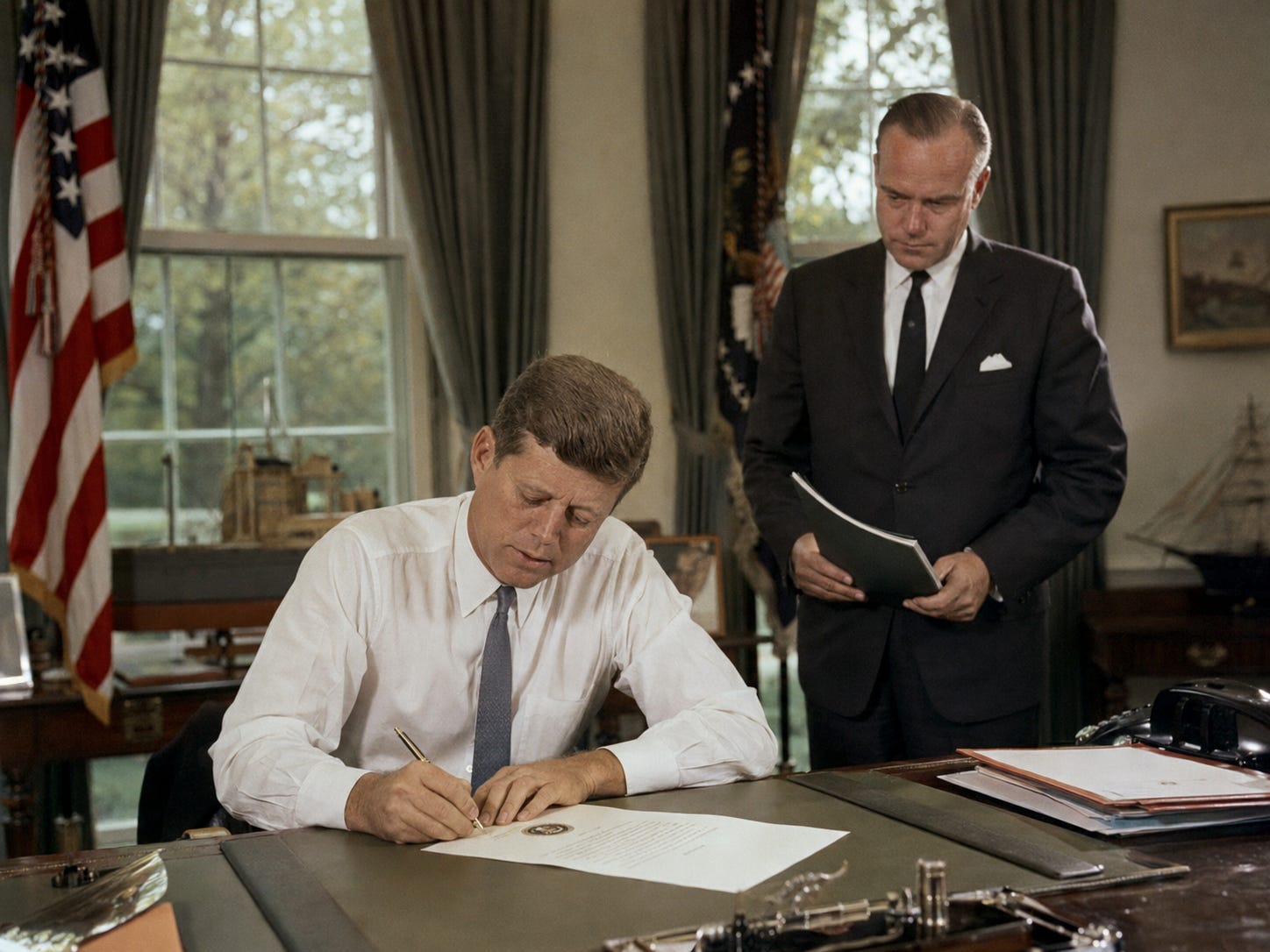
Kennedy signing the July 5 letter to Eshkol
The Eshkol government was stalling. The physics clock was running.
Miami had its own timing. The exile community was operationally warm through 1963 and the JMWAVE machine was still in place, but every month that passed put more institutional distance between the Bay of Pigs planners and the operational assets. The Miami window was closing on political time.
Dallas had its own timing. The oil depletion allowance was in the 1964 tax bill Kennedy was moving through Congress. If the bill passed with Kennedy alive, the allowance was gone. The Dallas window was closing on legislative time.
But the physics clock at Dimona was the one that could not be moved.
Political windows can be reopened. Legislative windows can be renegotiated. Operational windows can be reconstructed with new personnel. The physics clock of a breeder reactor going critical cannot be reversed. Once the plutonium exists, the strategic reality is different, and the leverage the American president has against the Israeli government is permanently reduced.
That is why the date was November 22, 1963. That is why not the next month. That is why not the following spring after the tax bill vote. The Miami grievance and the Dallas grievance would have tolerated a later date. The Angleton grievance and the physics clock in the Negev would not.
Three grievances, one window, one class underneath, and the reactor breathing in.
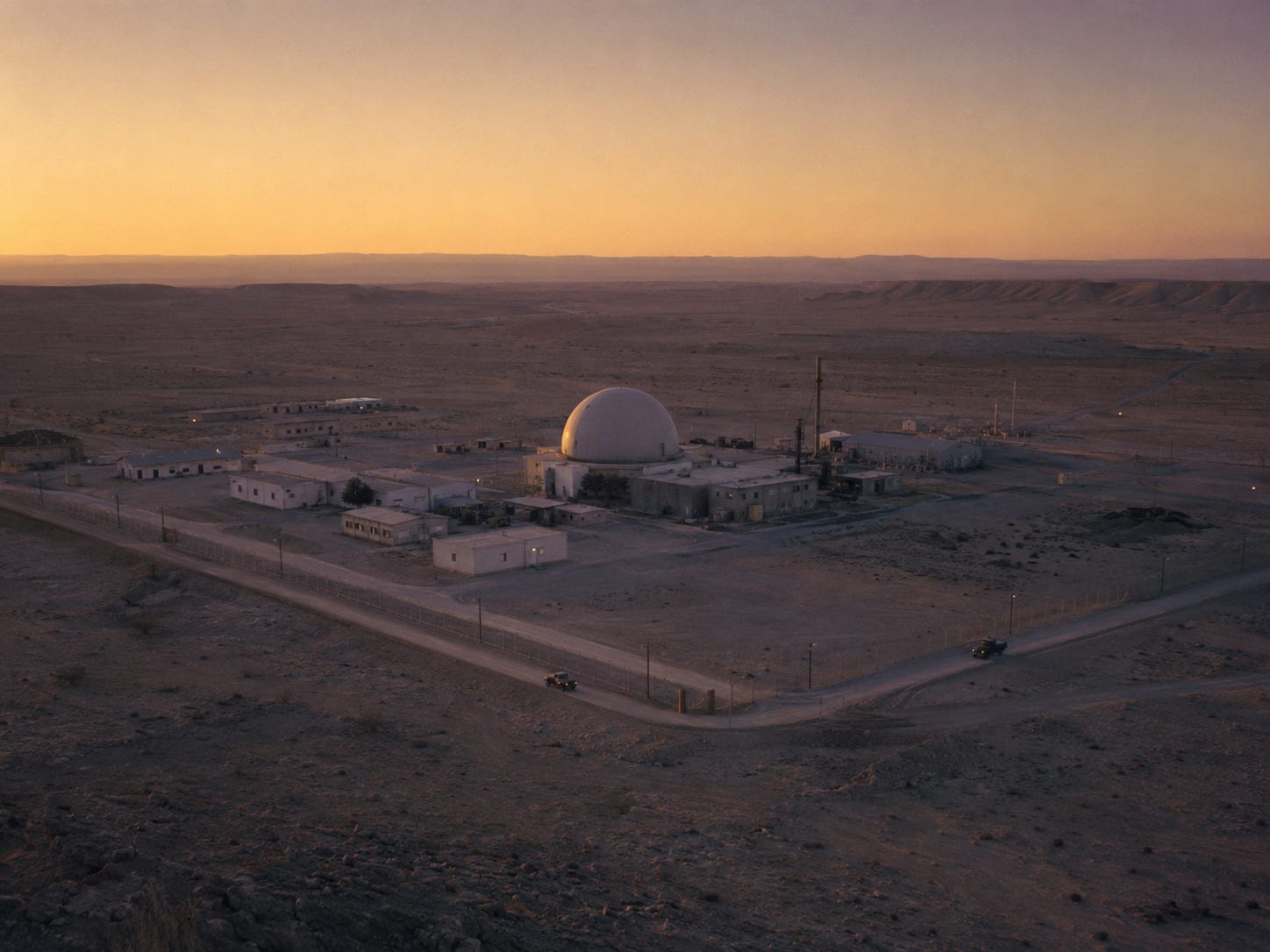
Dimona nuclear reactor complex in the Negev desert at dusk, 1963
The physics clock set the date. The historians disagree on what happened after.
📖 The Continuity Thesis
The mainstream continuity thesis, argued by scholars including my former professor Larry Berman at UC Davis, reads NSAM 273 as substantially continuous with Kennedy’s stated policy. Berman argues the November 21 draft was routine NSC preparation for the Honolulu Conference already scheduled for November 24. He argues the language in the signed November 26 document reaffirms Kennedy’s stated objectives and that paragraphs 7 and 8 authorize a planning framework Kennedy would have signed after Honolulu based on the deteriorating military situation. His reading treats the November 21 date as scheduling coincidence and the November 26 signature as continuation. This is the argument Berman developed across his major books on the Kennedy-to-Johnson transition, including Planning a Tragedy and Lyndon Johnson’s War.
The Berman continuity thesis is a policy claim, not an assassination claim. Berman does not argue Johnson orchestrated November 22 and Part 8 does not argue Berman defends the orchestration. The dispute is narrower.
Berman built the continuity thesis before the March 18, 2025 unredaction of the Sullivan memo. His major work on the Kennedy-to-Johnson transition was written between the 1980s and the 2000s, when the specific documentary evidence that CIA directors permitted Angleton to run intelligence projects with the Israeli Intelligence Service was still classified. Berman built the thesis on the assumption that Kennedy’s foreign policy apparatus was operating on a unified basis. The four-word unredaction shows that assumption was incomplete. There was a compartment inside CIA running an intelligence liaison with Israel while Kennedy was pressuring Ben-Gurion and Eshkol on Dimona. That compartment does not appear in Berman’s framework because the compartment was not on the public record when the framework was developed.
This is not a criticism. Berman wrote responsibly with the evidence available. He is one of the most rigorous Vietnam scholars of his generation and I took his seminar at UC Davis. The observation is narrower. A continuity thesis built without access to the Angleton compartment has to be revisited once the compartment is documented. That revision is not a repudiation of Berman’s scholarship. It is what Berman himself trained his students to do when the evidentiary base expands.
The counterfactual holds only if the president who was carrying the Trade Mart speech to Dallas on November 22 was also prepared to sign a planning framework for expanded covert action against North Vietnam four days later. The Trade Mart speech makes that counterfactual harder to sustain. The speech Kennedy was going to deliver in Dallas on November 22 attacks the voices counseling extremism and the far-right doctrine that peace is a sign of weakness. It argues that American strength must be measured by the wisdom with which we use that power. He was carrying that speech into the political heartland of the class of 1949 and he was going to deliver it to the Dallas Trade Mart audience of the same business class that had been funding the anti-Kennedy political infrastructure since 1961.
The full text of JFK’s speech is at the bottom of Series 2 Part 2. Read what he was going to say. Then read paragraphs 7 and 8 of NSAM 273. Then decide whether the same president signs both.
Berman reads NSAM 273 as continuity. The receipts pattern does not require the reader to agree. It requires only that the reader read what happened after.
📁 The Receipts
Every operational hypothesis is testable against what happened after.
The Kennedy administration had, in the six months before Dallas, taken a series of positions that pointed at disengagement from Vietnam. National Security Action Memorandum 263, signed by Kennedy on October 11, 1963, ordered the withdrawal of one thousand American military personnel from South Vietnam by the end of that year and set the framework for full withdrawal by the end of 1965. Robert McNamara had returned from Vietnam and briefed the president on the withdrawal timetable. The policy trajectory in October 1963 was clear. Kennedy was disengaging.
On November 21, 1963, McGeorge Bundy prepared a draft of a new National Security Action Memorandum, numbered 273, that reversed the trajectory. The draft existed the day before Kennedy landed at Love Field. Bundy was the president’s own National Security Advisor. The reversal document was already in circulation inside the executive branch twenty-four hours before the specific event that would make its adoption inevitable.
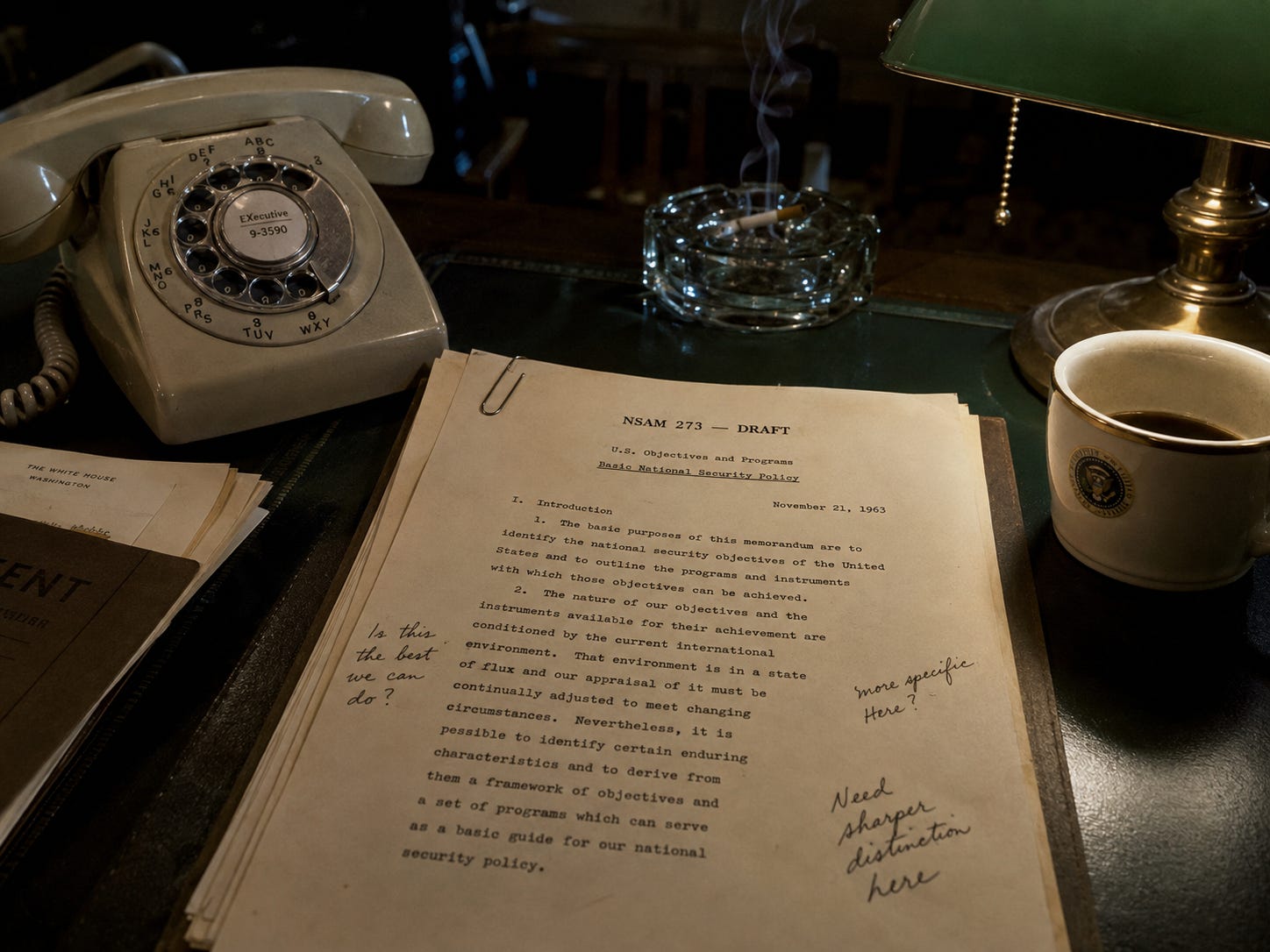
Bundy draft on the Situation Room desk, November 21
Kennedy was shot on November 22, 1963.
Lyndon Johnson signed NSAM 273 on November 26, 1963. Four days after the assassination. The document rescinded the disengagement framework. It authorized planning for expanded operations against North Vietnam. It set the trajectory that led directly to the Gulf of Tonkin Resolution in August 1964 and to the full military escalation that followed. The Vietnam War that killed fifty-eight thousand Americans and killed several million Vietnamese was unlocked by a policy reversal whose draft memo existed the day before the assassination and whose signed version existed four days after.
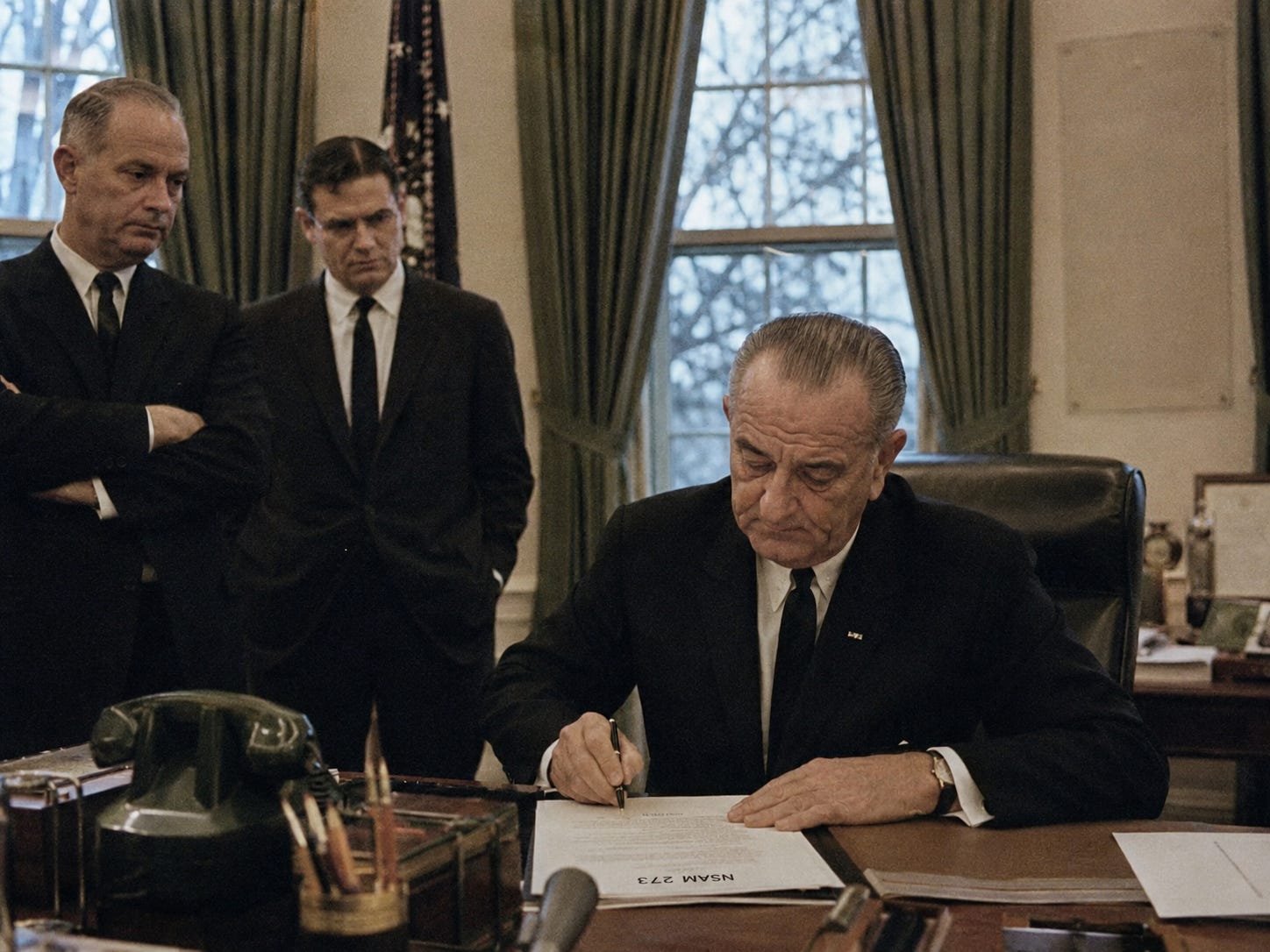
Lyndon Johnson signs NSAM 273, November 26, 1963. Four days after the assassination.
The receipts on the financial side of the geometry are equally documented.
D.H. Byrd, who owned the Texas School Book Depository on November 22, 1963, was a founding investor in Ling-Temco-Vought. LTV received massive military contracts as Vietnam escalated. Its A-7 Corsair II attack aircraft became one of the primary strike aircraft of the war. The value of Byrd’s LTV holdings appreciated in ways that turned the Texas oilman’s aerospace investment into one of the individual American fortunes most directly enhanced by the specific war whose escalation was unlocked by the specific reversal signed four days after the specific event that occurred in the specific building he specifically owned.
Byrd was a Del Charro regular. The man who owned the building profited from the war. The war was unlocked by the reversal. The reversal draft existed the day before. The reversal signature existed four days after. The chain of receipts runs through a single set of relationships that met annually in a hotel on the Pacific.
This is not a coincidence pattern. This is a receipts pattern.
The class of 1949 had lost China and had promised itself it would not lose again. The specific policy reversal that unlocked the Vietnam military expenditure was drafted the day before Kennedy died and signed four days after. The specific man who owned the building Kennedy was shot from was simultaneously a founding investor in one of the defense contractors whose stock climbed on the specific war the reversal unlocked. And the specific Texas oilman who hosted the FBI Director for nineteen consecutive summers, who financed Joseph McCarthy’s political operation against General Marshall for losing China, and who served as the connective institution between Texas money and federal law enforcement, was the same Clint Murchison whose La Jolla hotel served as the physical venue where the class of 1949 held its unminuted meetings.
Receipts do not prove intent.
Receipts prove alignment.
The alignment was total.
🔥 The Verdict
Sixteen articles. Four words. One answer.
The answer is not a name. The answer is a geometry.
President John F. Kennedy was killed on November 22, 1963 in Dallas, Texas by an operation whose planners understood that three constituencies with three distinct grievances converged on the same window, and whose financiers sat at the geometric center of that convergence because they belonged to a class that had already lost a country in 1949 and was determined not to lose again.
The Miami operational infrastructure supplied the assets. The Angleton counterintelligence compartment inside CIA supplied the sterile channel and the Mexico City choreography. The Dallas financier class supplied the money, the political cover, and the venue. The ultra-rich anti-communist consciousness supplied the shared worldview that made all four constituencies act as if they were coordinated when they were only aligned.
The specific individual who fired the specific rounds is a technical question that the surviving evidentiary record does not resolve. The Zapruder film shows what it shows. The acoustic evidence the HSCA analyzed shows what it shows. The Parkland doctors described what they described. The autopsy at Bethesda described something different. The surviving witnesses split in ways that suggest more than one shooter, and the surviving documentation is the small fraction of what the classification system has not destroyed or withheld.
But the technical question of who pulled the specific trigger is not the load-bearing question of the sixteen-article arc. The load-bearing question is who wanted the president dead badly enough to make the operation viable, and why the date could not slip.
The answer is the class that had lost China. The date could not slip because the reactor at Dimona was breathing in. And the four words the CIA hid for fifty-eight years point exactly at the compartment inside American intelligence that ran the Israel liaison and understood the physics clock better than any elected official.
CIA directors permitted Angleton to run several intelligence projects, many of them with the Israeli Intelligence Service.
That is the sentence W.C. Sullivan wrote in 1967. That is the sentence four consecutive administrations chose to hide the country name inside of, across four release cycles, across eight years, across two Democratic administrations and two Republican administrations. That is not a partisan concealment. That is an institutional concealment.
The institution knew. The institution knows. The institution has kept knowing for sixty-two years.
The verdict is not a trial verdict. The record is too damaged for a trial verdict. The record has been deliberately damaged by seventy-three years of judicial architecture that Series 2 Part 7 documented in detail.
The verdict is a journalistic verdict. It is the argument the surviving evidence supports. It is the account that explains the physics clock, the four words, the Dallas weekend, the Miami operational grievance, the Angleton compartment, the Dimona timeline, the depletion allowance politics, the Sassoon and Rockefeller and Duke experience of what happens when a country walks out from under you, and the specific fact that the surviving Kennedy documentation is still fighting its way through the classification system in 2025.
The pattern is the point.
The evidence is in.
The verdict is that the sixteen-article arc identifies the class, the geometry, the physics, and the four words that together explain November 22, 1963 better than any competing account in the public record.
The remaining question is not whether the class of 1949 wanted Kennedy dead. The class made itself extremely clear at the time. The remaining question is whether the American political system is capable of releasing the sixteen documents Kiriakou says will never come, the 10,000 documents that Series 1 named, and the compartment records that Series 2 traced.
If those documents come, the verdict becomes a trial verdict. If they never come, the verdict stays a journalistic verdict.
Either way, the four words are unredacted now.
They are on the record.
The name of the country is in the memo.
💡 Final Thought
The people who lost China in 1949 did not want revenge. They wanted a policy. They wanted an American political system that would never again permit a communist regime to consolidate inside a market they cared about. They funded the China Lobby, the Committee of One Million, the anti-communist right, the political infrastructure of Dallas, and the counterintelligence compartment inside CIA that understood a strong Israel as a strategic asset against Soviet influence in the Middle East.
None of that required a conspiracy.
It required a class with a memory and money and a shared understanding of what the ending looks like when you get it wrong.
The Kennedy brothers walked into that class in January 1961. By November 1963 they had given the class every signal that they did not share the memory. And the class had access to the operational, financial, and counterintelligence infrastructure that made the specific event on the specific date on the specific calendar viable.
The four words the CIA hid for fifty-eight years point at the compartment.
The compartment points at the class.
The class points at 1949.
And 1949 points at the specific consciousness that watched a president in 1963 and decided the movie was going to end differently this time.
That is the pattern.
That is the verdict.
Keep pulling.
THE END
Thank you for any support you can provide!
The readers who share this piece are the ones keeping independent reporting alive. Every restack widens the circle. Every forward to a friend or colleague is a quiet vote for journalism that answers to its readers, not its advertisers.
And for those who choose to, the $3 tip jar is open below. It is less a payment than a small act of allegiance, a way of saying you stand with the work.
🧭 What Comes Next
The Verdict closes Series 2 of JFK: Too Big to Fail. Sixteen articles. Four words. One class of 1949.
But the class of 1949 did not die in Dallas. It ratified Dallas. The doctrine it authored did not close with the Warren Commission. It kept executing.
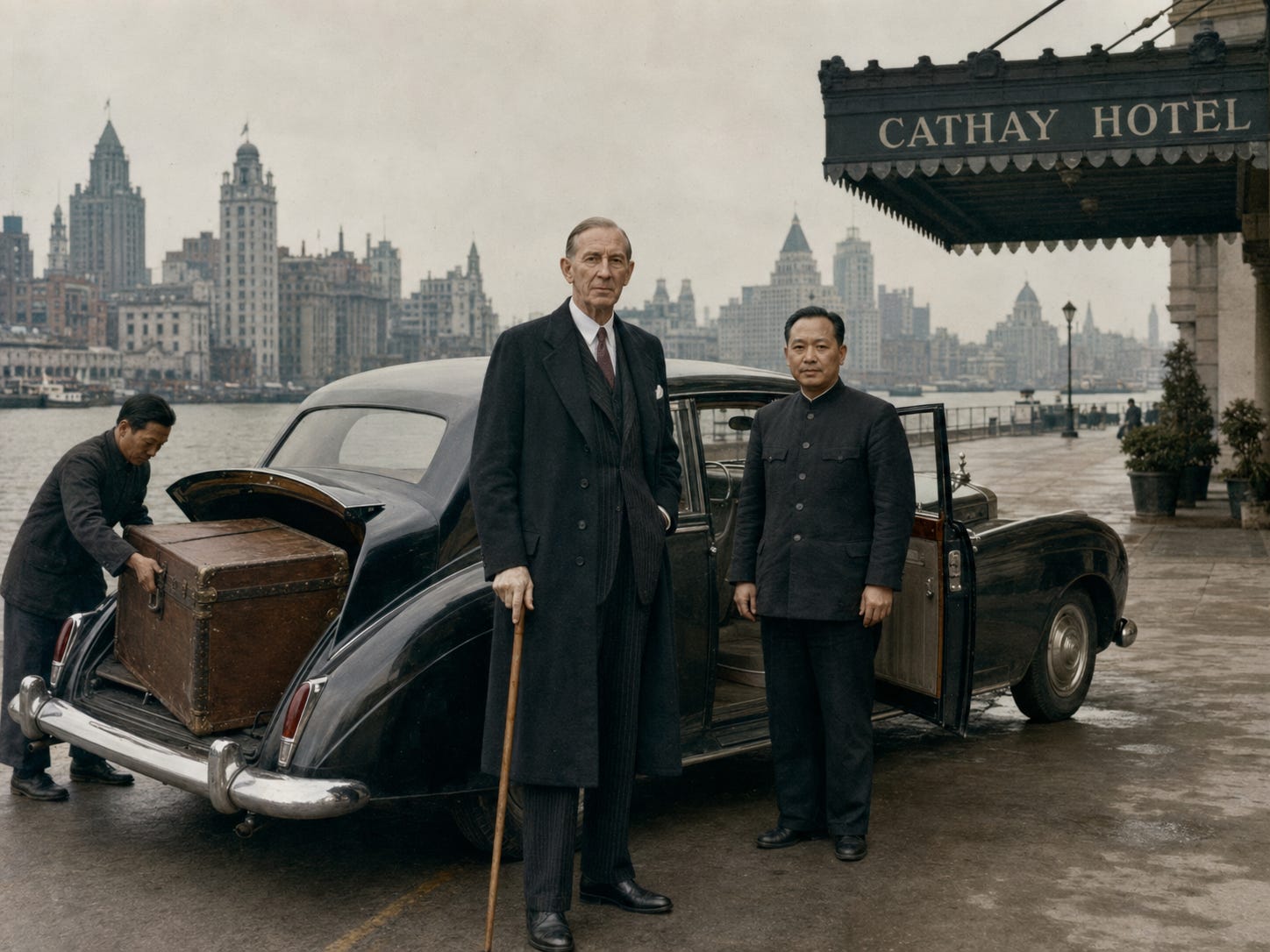
Victor Sassoon leaves Shanghai, 1949. As China falls, one world gives way and another begins.
Series 3 opens with The Day After Doctrine. It walks the trustee layer above the operational tier. John J. McCloy and Allen Dulles as the men who translated consensus into action, not the men who authored it. And it names the five-node principals architecture above the trustees.
The Rockefeller Family Council. The European banking dynasties. The Pilgrims Society and Anglo-American fraternity layer. The central banking coordination layer running through the Bank for International Settlements, the Federal Reserve, and the Bank of England. And the Round Table successor institutions at the Council on Foreign Relations, Chatham House, and Bilderberg.
Series 1 and 2 asked who killed Kennedy. Series 3 asks who ratified the killing.
The distinction is not academic. The same ratification mechanism executed in Memphis in April 1968. In Los Angeles two months later. In the Church Committee closure operation that neutered the 1970s oversight response. In Iran-Contra. In the 2001 architecture. In the Epstein network. In every subsequent inflection point where the five-node consensus forms in real time and the trustee layer translates the nod into action.
The trustees who ran Chase Manhattan and Sullivan and Cromwell and the Council on Foreign Relations in 1963 are gone. The five nodes above them are not. The Rockefeller family office is intact. The European banking dynasties have consolidated and quietly persisted. The Pilgrims Society still meets. Chatham House still publishes. Bilderberg still convenes. The Council on Foreign Relations still runs the study groups. The Bank for International Settlements still coordinates the central banks from a Swiss tower with sovereign immunity from every national court on earth.
Series 3 traces the doctrine forward through each of them. At the central banking node, Series 3 merges with the Sovereign Immunity Series. The BIS is one of the five doctrinal nodes. It is also the one node that answers to no court in any country. Readers who have followed the Sovereign Immunity arc already know the architecture. Readers who have followed the JFK arc already know the doctrine. When the two merge, you will see why the Day After Doctrine has held for sixty-three years and why the class that ratifies it has not lost a market at China scale since 1949.
When Series 3 and the Sovereign Immunity Series meet, you will have the full map.
Thank you for any support you can provide!
The readers who share this piece are the ones keeping independent reporting alive. Every restack widens the circle. Every forward to a friend or colleague is a quiet vote for journalism that answers to its readers, not its advertisers.
And for those who choose to, the $3 tip jar is open below. It is less a payment than a small act of allegiance, a way of saying you stand with the work.
❓ Before you go: Now that the four words are unredacted and the class of 1949 is on the record, do you believe the remaining 10,000 documents will ever be released, or will the classification system hold the vault closed for another sixty-two years? Drop your answer in the comments. I read every one. 👇
Series 2 Navigation
JFK: Too Big To Fail
PART 1 => PART 2 => PART 3 => Evidence Ledger => PART 4 => PART 5 => Part 6 => Part 7
Series 1 Navigation
WE KNOW WHO KILLED KENNEDY
Part 1 Part 2 Part 3 Part 4 Part 5 Part 6 Part 7 Part 8
The Sovereign Immunity Series Navigation
Part 1 => Part 2 => Part 3 => Part 4 => Part 5
📚 References
Caro, R. (2012). The Passage of Power: The Years of Lyndon Johnson, Vol. 4. Alfred A. Knopf.
Cohen, A. (1998). Israel and the Bomb. Columbia University Press.
Douglass, J. W. (2008). JFK and the Unspeakable: Why He Died and Why It Matters. Orbis Books.
Fonzi, G. (1993). The Last Investigation. Thunder’s Mouth Press.
Gentry, C. (1991). J. Edgar Hoover: The Man and the Secrets. W.W. Norton and Company.
Hersh, S. M. (1991). The Samson Option: Israel’s Nuclear Arsenal and American Foreign Policy. Random House.
Kaufman, J. (2020). The Last Kings of Shanghai: The Rival Jewish Dynasties That Helped Create Modern China. Viking.
Koen, R. Y. (1974). The China Lobby in American Politics. Harper and Row.
Kvalvik, R. (2026). We Know Who Killed Kennedy, Part 4: The Boardroom With No Minutes. Waves and Positions.
Morley, J. (2017). The Ghost: The Secret Life of CIA Spymaster James Jesus Angleton. St. Martin’s Press.
Newman, J. M. (1992). JFK and Vietnam: Deception, Intrigue, and the Struggle for Power. Warner Books.
Oshinsky, D. M. (1983). A Conspiracy So Immense: The World of Joe McCarthy. Free Press.
Prouty, L. F. (1992). JFK: The CIA, Vietnam, and the Plot to Assassinate John F. Kennedy. Birch Lane Press.
Scott, P. D. (1993). Deep Politics and the Death of JFK. University of California Press.
Summers, A. (1993). Official and Confidential: The Secret Life of J. Edgar Hoover. G.P. Putnam’s Sons.
Berman, L. (1982). Planning a Tragedy: The Americanization of the War in Vietnam. W.W. Norton and Company.
Berman, L. (1989). Lyndon Johnson’s War: The Road to Stalemate in Vietnam. W.W. Norton and Company.
Illustration created using generative AI tools for editorial purposes.
This piece was drafted with AI assistance and rigorously edited by the author. All analytical conclusions, sourcing decisions, and editorial framing are the author’s. AI was used as a drafting and research aid, not as a decision-making authority.
Discussion about this post
https://wavesandpositions.substack.com/p/jfk-too-big-to-fail-part-8-the-conculsion


I haven't even finished reading this and I had to say one thing. I am SICKENED that our current National Defense Appropriations Authorization has, buried within it, "a little thing called Section 219", which basically embeds the Israeli Defense Force into our military, without any kind of a vote of the people. I never had a single thing about Israel in my life, but I have fucking had it.
I just happened to be reading Libra by Don DeLillo for the third time when I noticed your articles. I was eleven years when JFK was assassinated. I remember the grown-ups saying that we would never know the truth. Reading Libra and your articles was like time travel. America changed on November 22, 1963. And it was not for the better.